
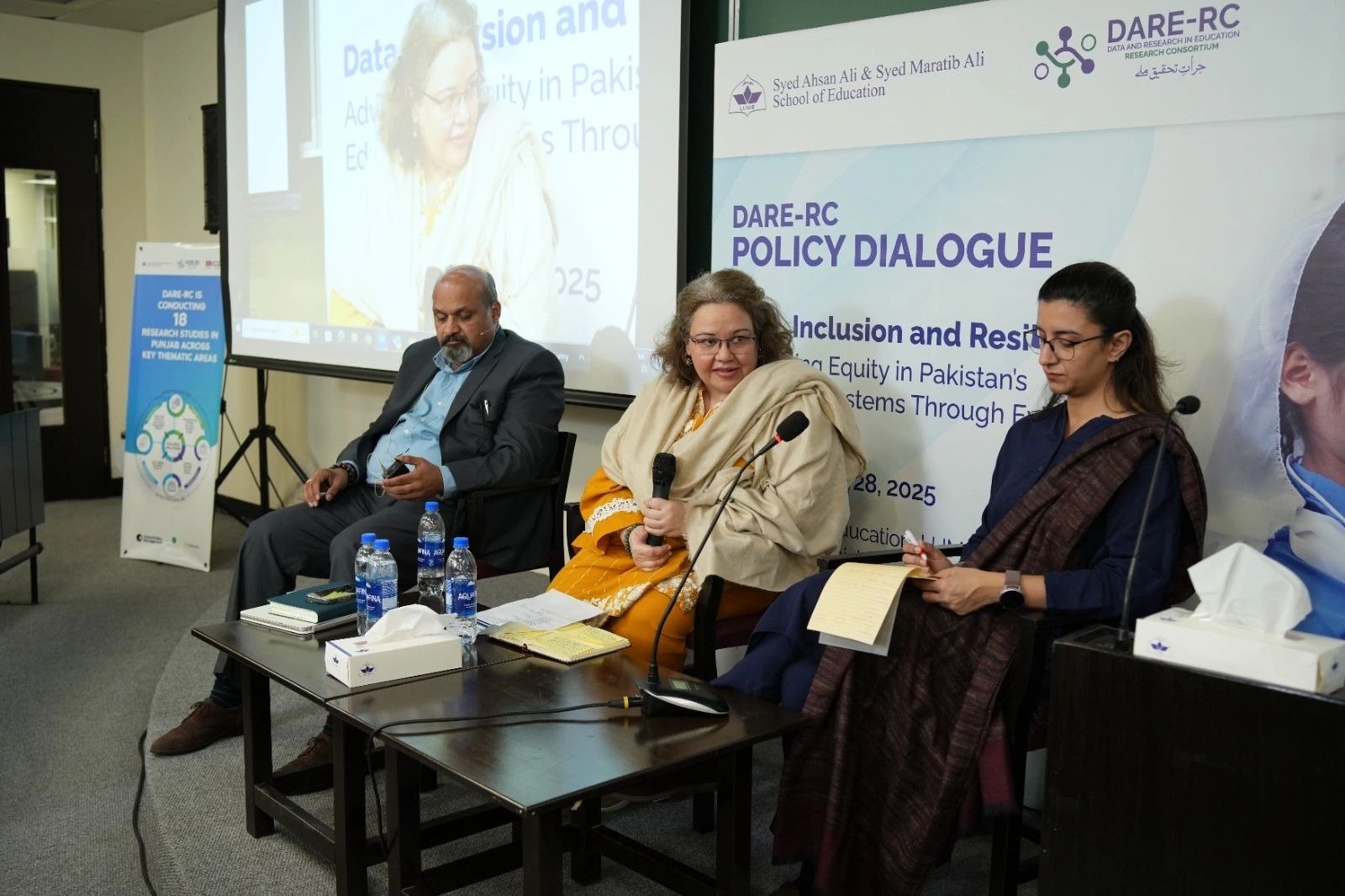
In the face of widening disparities in learning, education experts and researchers gathered at the LUMS School of Education to explore data-driven insights and inclusive approaches for advancement of equity for learners across Pakistan. The Syed Ahsan Ali & Syed Maratib Ali School of Education (SOE) at LUMS, in collaboration with the Data and Research in Education Research Consortium (DARE-RC), hosted this policy dialogue bringing together key representatives from academia, government and development partners. The motive was to deliberate on how evidence and data can be leveraged to build equitable and disability-inclusive education systems. They also tried to explore how robust disability-inclusive data can drive effective planning, budgeting and policy decisions.
This dialogue represents a significant milestone in a joint effort to translate the contextual evidence generated by DARE-RC into meaningful policy and practice discussions. Hosted at the LUMS School of Education, this discussion aims to foster a sustainable, locally-driven push for evidence-based education policy frameworks in Pakistan.
In his opening remarks, Mr. Salim Salamah, Deputy Group Head (Health, Education, and Democracy) at the British High Commission, underscored that the research studies undertaken through DARE-RC form an integrated ecosystem; one that strengthens the national research infrastructure while cultivating a sustained community of practice. He noted that this programme not only generates rigorous evidence but also connects researchers, practitioners and policymakers in a way that ensures the continuity of dialogue well beyond the life of individual projects. Mr. Salamah emphasised that while structural reforms are often bounded by political or administrative cycles, the relationships forged through this research community create enduring mechanisms for evidence use. By bringing together a research system and a committed cohort of academics focused on improving access and quality in education, DARE-RC is helping to build a lasting legacy: a culture where policymaking in Pakistan is increasingly informed by credible, contextually grounded evidence
Prof Dr. Tayyaba Tamim, Dean of the School of Education at LUMS, highlighted that Pakistan is ranked among the seven most climate-vulnerable countries in the world, which makes it critical for our education systems to stay resilient. And resilience doesn’t mean returning to where we started, it’s an iterative cycle. We must not simply react to climate change, but respond to it in ways that help us move forward, even as disruptions grow. This dialogue is part of our ongoing commitment to think about where resilience and inclusion can take us. Whether we talk about resilience or inclusive education, none of it is possible without data. We need data to frame and understand the problem, and it is only through data that research can meaningfully inform policy.
Ms. Saima Anwar, Program Director, DARE-RC, alluded to the need for sustaining a community of practice beyond the program’s lifecycle. She highlighted LUMS’s vital role in supporting this continuity, especially following Pakistan’s recent education emergency, and noted that such collaboration ensures locally grounded research continues to inform meaningful policy change.
The session was structured around key themes such as Predictive Modelling of Policy Impact on School Enrolment, inclusive community-based participatory research in urban and rural Pakistan, and Disability-Inclusive Data and Systems. Academics and researchers stressed that impactful education reforms must be built on robust evidence, noting that data-informed and inclusive strategies are vital for advancing equity and improving outcomes for marginalised learners.
While highlighting the use of predictive modelling to analyse policy impact on school enrolment, Dr Farah Nadeem stated that this ambitious project uses innovative data methods and machine learning to pinpoint what drives access to education. Although attitudes are positive, economic constraints remain the strongest influence, with nearly half of respondents forced to choose between schooling and other basic needs.
Dr Zahid Majeed reflected on resilient education systems for adolescent learners, drawing on community-based participatory research from urban and rural Pakistan. He emphasized “Recent heatwaves and floods have reshaped how adolescents perceive risk and resilience and our participatory research highlights the need to strengthen community roles, preparedness and inclusion across school systems.”
The final presentation, delivered by Iftaq Khaliq Khan focused on disability-inclusive data systems and the integration of the Washington Group Questions into Pakistan’s Annual School Census. He highlighted the importance of using the Washington Group Short Set to standardize disability identification, enabling more accurate, comparable and functional assessments across education systems.
The session concluded with an interactive panel dialogue including Dr. Farah Said, Dr. Faisal Bari and Dr. Razia Sadik, exploring emerging evidence on system readiness, learning experiences and data integration across diverse contexts. During the panel discussion, speakers emphasized that low-hanging reforms can quickly emerge when evidence is meaningfully used, but data tools must remain dynamic and continuously updated rather than static. Panelists noted that most policymakers are not proficient with large datasets, making it essential for researchers to present data in simplified and decision-friendly formats. They also underscored that disasters are not only natural but also man-made, and that climate-related impacts disproportionately affect marginalised learners. The discussion further highlighted the need for social protection and school safety policies that extend beyond education alone, along with careful planning for implementation. Panelists reiterated that high-quality, standardized data is a ‘double-edged sword’: when accurate, it can strengthen planning, but if misinterpreted, it leads to unclear insights and weak results.
Following its broader mission, DARE-RC is a pioneering collaborative knowledge-building programme aimed at empowering policymakers to drive education reform. It is implemented by Oxford Policy Management (OPM) in partnership with the Aga Khan University Institute for Educational Development (AKU-IED), and Sightsavers, and is funded by the UK Foreign, Commonwealth and Development Office (FCDO). Through strategic dialogues with key institutions like the LUMS School of Education, the consortium helps cultivate a lasting culture of effective data-use for education policymaking, ultimately benefiting all children, especially the most marginalised.