
The Context
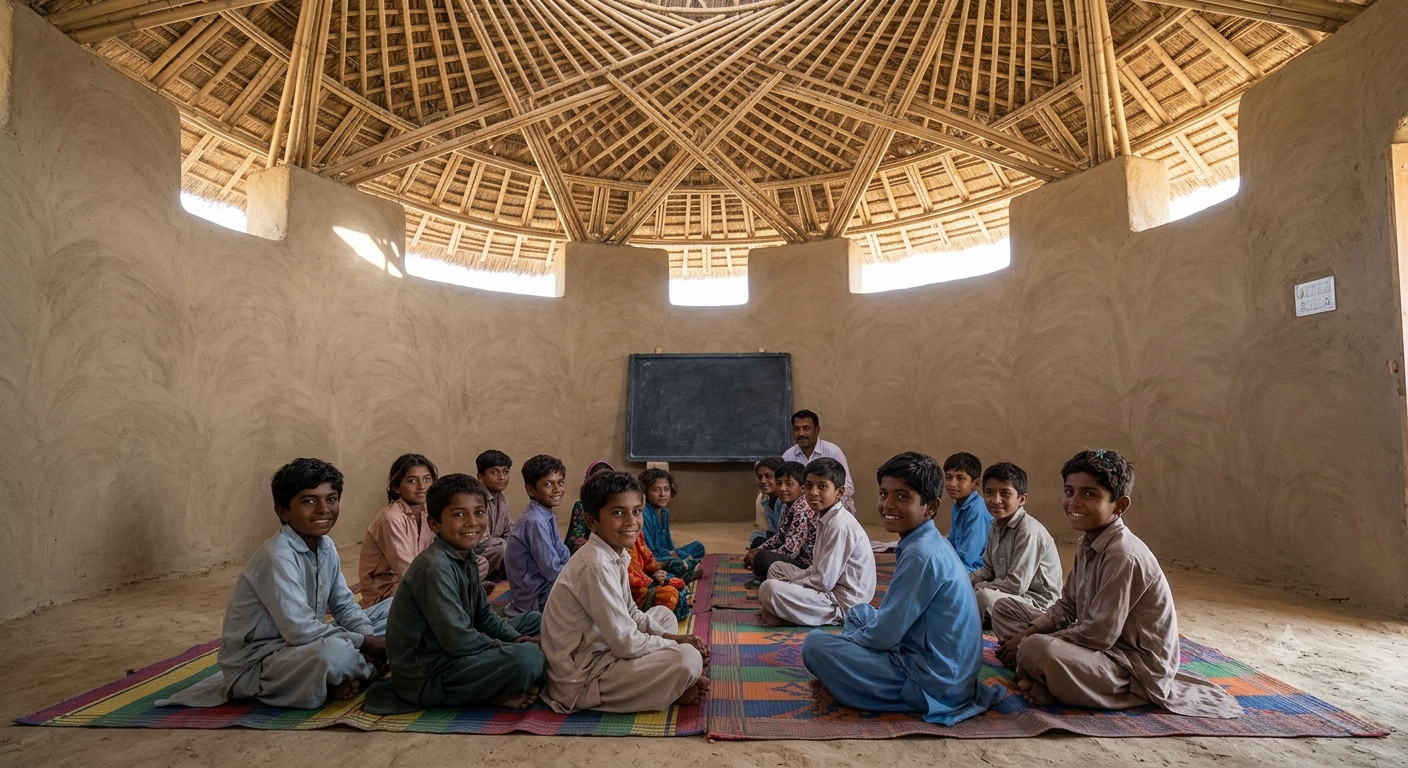
Two hundred kilometres east of Karachi, where the irrigated plains of the Indus give way to the dunes of the Thar, sits a district unlike any other in Pakistan. Umerkot is the only non-Muslim-majority district — 54.7% of its roughly 1.15 million residents are Hindu — and it shares a desert border with India. Sindhi is the mother tongue of more than 95% of the population (National Population Census, 2023), and the great majority live in rural areas, scattered across a landscape that has always demanded resilience from the people who call it home.
The chilli capital of Pakistan and the birthplace of the great Mughal Emperor Akbar, Umerkot, is also one of the most chronically under-resourced districts in Sindh. Decades of low investment in public services, a fragile agrarian economy, and recurring droughts have kept Umerkot near the bottom of the province’s human development indicators (UN-Habitat Pakistan, Country Report 2023). In recent years, climate change has sharpened those existing vulnerabilities rather than introducing new ones: Umerkot now sits among the districts most exposed to compounding climate shocks in Sindh, caught between worsening drought cycles and increasingly extreme heatwaves, with summer temperatures regularly pushing past dangerous thresholds. For families already living on thin margins, an extra month of failed rains or an early, brutal heat spell can be the difference between a child staying in school and a child going to work.
The TaRL Initiative
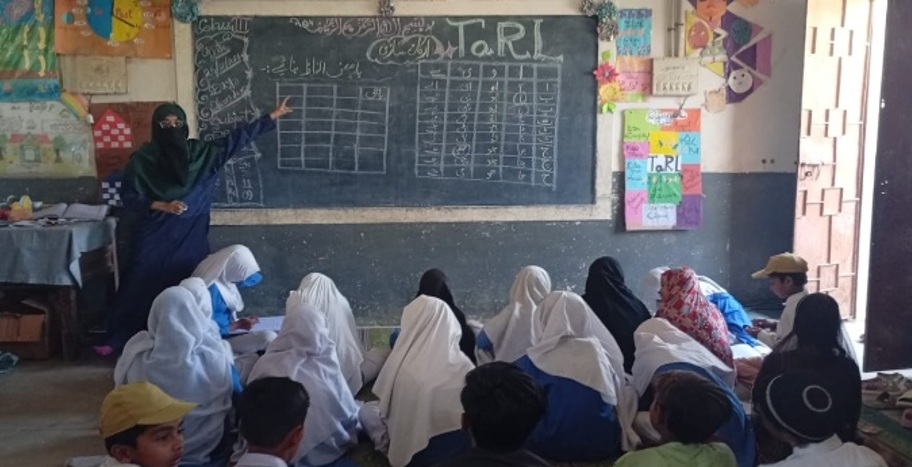
It is against this backdrop that the School Education & Literacy Department (SELD) has supported the action research initiative “Scaling TaRL Through Mainstream Systems” — alongside Karachi West, its densely populated urban counterpart, as part of the DARE Research Consortium programme. The goal was to test whether Teaching at the Right Level (TaRL), a pedagogy built around grouping children by learning level rather than grade or age, could be embedded into government schools at scale, under the Government of Sindh’s ownership.
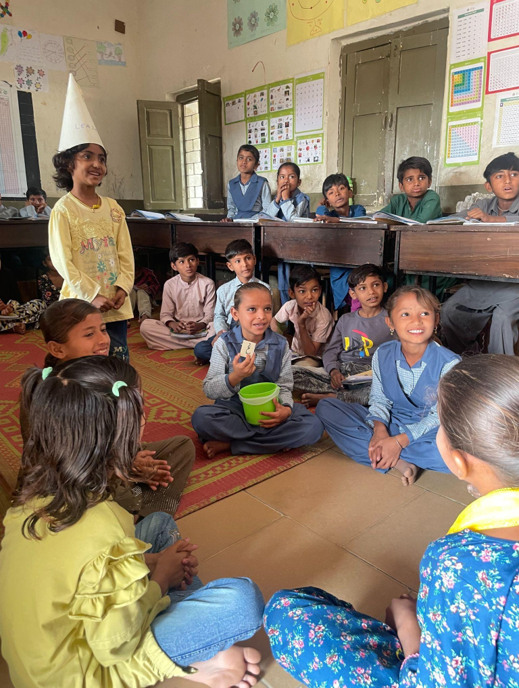
Over four rapid in-school cohorts, the project reached more than 20,000 students. The results, now consolidated under SELD, tell a clear story: in Urdu/Sindhi, the share of children stuck at the very beginning of the learning ladder (labelled as ‘Beginner Level’ where the child is not even at letter/alphabet identification stage) reduced — from 12.2% to 1.1% at the Beginner Level, while the share of children reading full stories more than doubled, climbing from 14.3% to 37.8%. This represents 7,606 students who could read stories by the end of the programme.
Numbers like these are, in the end, a story about thousands of individual children crossing a threshold from confusion to confidence. But the most vivid version of that story rarely lives in a dashboard. It lives in the children themselves.
Two Brothers, an Ancient Tradition
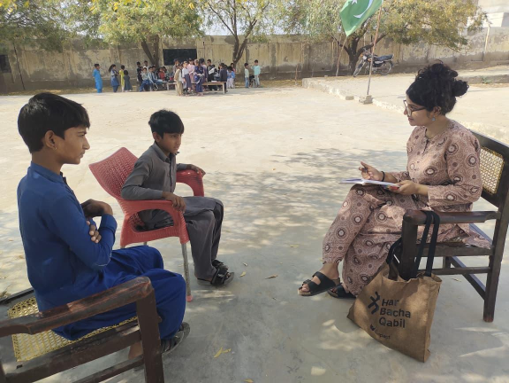
Among the children enrolled in Umerkot’s TaRL learning camps were two brothers, aged 13 and 11, from the Jogi community (one of South Asia’s oldest itinerant communities, with a presence across Sindh’s Tharparkar, Umerkot, Mirpurkhas, Badin, and Sanghar districts).
The Jogis are not a footnote to Sindh’s social fabric; they are one of its oldest threads. Many trace their spiritual lineage to the Nath Yogi order and to the worship of Lord Shiva, and for generations they have carried roles that blend the sacred with the practical: itinerant healers who use herbal and ritual knowledge to treat the sick, oral historians who preserve genealogies and folk epics that exist nowhere in writing, and poets who perform verse passed down through unbroken chains of memory rather than manuscript. Theirs is a semi-nomadic life by tradition and necessity — moving with the seasons, with labour opportunities, with the rhythms of a desert economy that has never offered much certainty.
It is no accident that Umerkot’s soil has also produced some of Sindh’s most revered Sufi voices. The district is closely associated with Rohal Faqir and Murad Faqir, two poets whose verses are still recited and sung locally as part of the region’s living mystical tradition. In a place where poetry is not a pastime but a vessel for memory, faith, and survival, the Jogi brothers’ inherited gift for storytelling and verse feels less like an exception and more like a continuation of something deeply rooted in Umerkot’s identity.
For the Jogis, schooling has historically been a challenge for their nomadic caste known to be mystics, snake charmers and folk musicians. The brothers’ family moves every few months — and in the past, that constant displacement meant constant disruption: arriving at a new place, half-settling into a routine, only to leave before it could take hold. Interest in school, understandably, tended to fade.
What changed, they said, was the TaRL learning camp itself. Unlike a conventional classroom built around a rigid syllabus and grade level, the camp met them where they were — structured around play, storytelling and making, peer collaboration, and learning pitched to what each child could actually do, not what a textbook assumed they should already know. The brothers described it simply: it had become the highlight of their day. Not an obligation layered on top of an already hard life, but the part of it they most looked forward to.
They have a younger brother, just four years old, too young yet for school. At home, the two older boys recreate the games and activities from the learning camp with him — turning what they absorbed into something they can pass down, almost instinctively, the way oral traditions have always moved through their community: sibling to sibling, generation to generation. When asked what they would do when their family moves again in two months, neither boy spoke of loss. They spoke of carrying it with them — the games, the habits of learning, the confidence — the same way their community has always carried its stories, its healing knowledge, and its songs from one place to the next. Did TaRL, by design, have enabled this level of articulation through a pedagogy rooted in the principles of social and emotional learning (SEL)?
The older of the two, when asked what he wanted to become, didn’t hesitate.
He wants to be a doctor – a Yogi Doctor!
What Resilience Looks Like Up Close
It would be easy to tell Umerkot’s story only through the lens of what it lacks — investment, infrastructure, rainfall, stability. All of that is real, and none of it should be minimised.
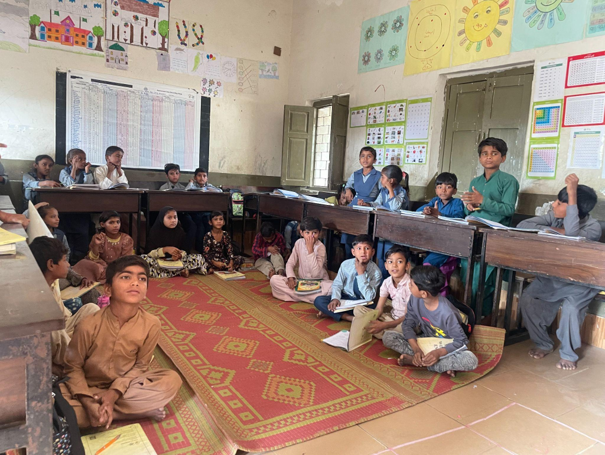
Yet the story of this district, and of this foundational learning initiative within a system, is also a story of what already exists over there in abundance: a centuries-old culture of healing and storytelling carried by communities like the Jogis. A literary heritage left behind by renowned poets, and now, a generation of children translating a few months of joyful learning into something they intend to keep — wherever the road takes them next. Behind this transformation were dedicated SELD teachers who believed and practiced the TaRL approach during regular school hours and classrooms, with measurable outcomes and made students learning-confident and happy.
Foundational learning, at its best, is not only about closing a literacy gap. It is about giving children like these two brothers something portable: a skill, a habit, a sense of what they are capable of, that survives the next move even when little else does.
Umerkot, located in the southeastern Sindh province of Pakistan, is geographically defined by a distinct divide between irrigated, fertile plains in its northern and western areas, and the arid, sweeping sand dunes of the Great Thar Desert in its southern and eastern regions.[1]
https://www.dawn.com/news/1926734
https://pide.org.pk/research/a-glance-at-socio-economic-realities-of-jogi-community
https://creid.ac/blog/2020/09/11/strangers-in-pakistan-jogi-community-denied-covid-relief/
https://sindhcourier.com/life-of-the-jogi-community/
[1] https://www.rspn.org/wp-content/uploads/2013/12/tahafuz-cause-study-kaplor.pdf