
What is the context?
According to the Climate Risk Index 2025, Pakistan ranked first amongst countries most affected by extreme weather events in 2022 (Germanwatch 2025). Pakistan also ranks highest in Asia on the Children’s Climate Risk Index (UNICEF 2021). As climate change drives more frequent and intense climate events, these conditions pose particularly severe risks to Pakistan’s children.
Recent climate-induced disruptive events displaced 8 million people in 2022 and virtually 3 million in 2025 in Pakistan, half of whom were children (IDMC 2023; UNOCHA 2025). Faced with a climate event, many migrate to informal settlements in urban and peri-urban areas from rural localities (USIP 2023). Given the varied nature of climate events and their impact, this migration can be temporary, seasonal, or permanent.
Sindh represents a particularly important context for examining these dynamics due to its increasing vulnerability to both rapid-onset and slow-onset climate events. These include recurrent flooding, droughts, sea intrusion in coastal areas, heatwaves, etc.
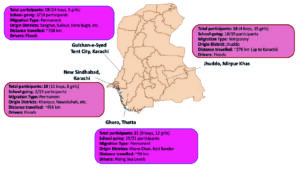
● Karachi increasingly functions as a destination for climate migrants, with settlements such as New Sindhabad, Gulshan-e-Syed Tent City, Musharraf Colony, Ibrahim Hyderi, and Rehri Goth hosting hundreds of thousands climate migrants. Sindhabad and adjoining informal settlements in Karachi house approximately 152,381 residents (2023 Census), including an estimated 91,000 children, virtually all of whom have little to no access to education post-migration. Gulshan-e-Syed Tent City hosts an estimated 7,000 residents (Shad 2024).
● Recent evidence indicates that over 12,000 individuals migrated from coastal villages in Thatta in a single year, largely due to sea intrusion and environmental degradation (IOM 2024). Approximately 200 families and nearly 900 children from Thatta’s coastal villages are estimated to have settled in Gharo.
● Following the 2022 floods, more than 470,000 people were displaced in Mirpur Khas district, with Jhuddo emerging as one of the most severely affected (Islamic Relief 2022).
● Projections suggest that Karachi could receive up to 2.4 million climate migrants by 2050, creating significant pressure on already overburdened urban infrastructure (MPI 2024).
However, reliable province-wide estimates of climate-induced child migrants (CCMs) remain unavailable. Existing data remains fragmented, location-specific, and largely captures immediate displacement and its short-term implications. As a result, existing evidence does not provide a holistic understanding of how many CCMs have migrated and where they have relocated. Little is known about how many remain out of school or their medium- and long-term educational needs related to access, continuity, and quality. There is also limited understanding of how intersecting factors, including gender, poverty, and minority status, shape children’s educational trajectories.
While provincial response effectively caters to children’s immediate survival needs, emergency recovery, and infrastructure rehabilitation, the scale and intensifying nature of climate threats necessitates moving beyond emergency response to adapt and respond to specific education needs of children. To effectively do this, future policy, planning and response must account for all CCMs, including seasonal, temporary and permanent migrants to ensure no-one is left behind.
This brief provides evidence to close the gap and strengthen existing frameworks to respond to CCM needs. Aligned with Priority Area Three: Resilient Education Service Delivery of DARE-RC’s Research Agenda, this brief draws from the study titled ‘Tracing Child Migrants’ Education Access, Continuity, and Quality Amidst Climate-Induced Disruptions in Pakistan’. The study assesses how climate-induced migration affects educational experiences of CCMs in two provinces, KP and Sindh. It does so by:
● Tracing the medium- and long-term educational trajectories of CCMs following climate-induced migration
● Exploring how gender, poverty, and religious minority status create overlapping disadvantages
● Examining the individual, household, community, and system-level factors shaping educational resilience.
● Producing evidence and targeted recommendations to support more equitable, inclusive, and resilient education policies and service delivery for CCMs.
What did we learn?
● With climate change displacing millions in Pakistan, Karachi alone can receive up to 2.4 million climate migrants by 2050, adding to settlements already crowded with migrants. Reliable data on how many of the displaced children remain out of school and what they need to stay in it is rare. This brief traces what happens to their education after migration, and what Sindh’s system needs to respond.
● Whether children can access school after migrating depends on where and how they settle: those settling within existing, functioning communities tend to stay connected to education, while those in isolated informal settlements are often completely cut off. Safety concerns, distance/transport barriers, documentation lost in disasters, and livelihood pressures prevent children’s access to education.
● Dropout rises sharply after migration, driven cumulatively by distance, safety, documentation, and livelihood pressures. Girls are held back by mobility and safety concerns, boys by the pressure to earn. Even where children do continue schooling, rigid transfer rules, grade repetition and language barriers common to Sindhi-speaking migrants moving into Urdu- or English-medium classrooms disrupt learning long after the initial disruption.
● Where communities are more established, teacher availability and regularity improve but in isolated settlements, and in the temporary learning centres set up after disasters, severe overcrowding, missing WASH facilities, and shortages of even basic learning materials make learning difficult. Many children also carry deep psychosocial distress from the disruption itself, though supportive teachers and peers can meaningfully shift this.
● Despite the barriers, children remain motivated to keep learning through self-study, independent exam preparation, and community-led efforts (e.g., a free tuition centre). But this support depends on individual initiative and local goodwill rather than a system families can rely on, and it fades if migration becomes prolonged.
● Addressing these challenges starts with removing the barriers that keep migrant children out of school in the first place, such as allowing provisional enrolment where documentation is missing, mandating that schools readmit migrant children even mid-year, and building disaggregated data on climate migrant children into Sindh’s existing education information system.
● Medium-term priorities include flexible, non-formal learning pathways for children balancing work and school, and community-based education models. Longer-term, this means formally recognising climate migrant children in Sindh’s education planning and budgets, inter-departmental coordination, and targeted financial support for the most vulnerable, including girls and religious minorities.
How did we learn this?
The study adopts a qualitative research design. It uses a participatory approach, centring the voices and lived experiences of CCMs. It also engages diverse stakeholders to develop a holistic understanding of educational access, continuity, and quality. The study is grounded in an integrated theoretical framework, combining human rights, intersectionality, and educational resilience perspectives to examine how barriers to education are experienced and navigated by CCMs. Given the involvement of children, the study adheres to strict ethical and safeguarding standards, including consent, confidentiality, the right to withdraw, and the ‘do no harm’ principle. The qualitative design prioritises in-depth findings and transferable insights, without assuming statistical representation of all CCMs in Pakistan.
Scope: CCMs are defined as children who moved from their habitual place of residence due to rapid-onset (such as floods) or slow-onset (such as erratic snowfall and droughts) climate events, whether by choice or necessity. The temporal scope focuses on climate migration from 2022 onwards, accounting for climate events such as floods and erratic snowfall. It includes participants aged 5–19 years, grouped into primary school aged-children (5–11), secondary school-aged children (12–16), and older youth (17–19 who were 16 at the time of climate-induced migration). Migration may be temporary, seasonal, or permanent.
Sampling Strategy: Sampling followed a purposive strategy to capture diverse lived experiences across gender, schooling status, socioeconomic background, and minority status. This was complemented by snowball sampling to reach harder-to-access populations.
Study methods: The study relied on the following:
● Desk review conducted to examine existing literature, policy frameworks, and evidence on climate migration and education in Pakistan.
● 40 participants engaged through Semi-Structured Interviews (SSIs) to capture detailed first-hand experiences of CCMs.
● 38 participants engaged through Focus Group Discussions (FGDs) to explore shared educational experiences and barriers post-migration.
● 8 Key Informant Interviews (KIIs) conducted with teachers, local leaders, service providers, and government officials.
● 20 participants engaged through multi-stakeholder consultations — including the Sindh Education and Literacy Department (SELD), the Sindh Education Foundation (SEF), the Provincial Disaster Management Authority (PDMA) Sindh, UNICEF, IOM — to validate findings and incorporate expert input.
Data Collection: Fieldwork was conducted in December 2025 in four research locations in Sindh: 1) New Sindhabad, Karachi; 2) Gulshan-e-Syed Tent City, Karachi; 3) Gharo, Thatta; and 4) Jhuddo, Mirpur Khas.