
What is the context?
Pakistan ranked first amongst countries most affected by extreme weather events in 2022 (Climate Risk Index 2025) and highest in Asia on the Children’s Climate Risk Index (UNICEF 2021). As climate change drives more frequent and intense climate events, these conditions pose particularly severe risks to children in Pakistan. In Pakistan, climate events displaced eight million people in 2022, and three million in 2025, half of whom are children (IDMC 2023; UNOCHA 2025). Projections for 2050 suggest millions more will become climate migrants in Pakistan, yet national and provincial level understanding on climate-induced child migrants’ (CCMs) experiences in access, continuity, and quality of education remains limited.
Khyber Pakhtunkhwa remains at the frontline of the climate crisis in Pakistan, faced with intensifying climate events, extreme weather in its mountainous terrain and Glacial Lake Outburst Floods (GLOFs). Following the 2022 and 2025 floods, over 250,000 children aged 6–17 were displaced (Islamic Relief 2022; UNOCHA 2025). While these numbers capture temporary displacement from the floods, they do not account for subsequent climate-induced migration, including long-term permanent migration patterns, as well as repeated seasonal migration. As a result, existing data fails to capture the number of CCMs. Little is known about how many remain out of school, as well as their medium- and long-term educational needs related to access, continuity, and quality. It also provides limited understanding of how intersecting factors, such as gender, poverty, and identity status, shape educational experiences.
While provincial response effectively caters to CCMs’ immediate survival needs, emergency recovery, and infrastructure rehabilitation, the scale and intensifying nature of climate threats necessitates moving beyond emergency response to adapt and respond to specific education needs of children. To effectively do this, future policy, planning and response must account for all CCMs, including seasonal, temporary and permanent migrants to ensure no-one is left behind.
This brief provides evidence to close the gap and strengthen existing frameworks to respond to CCM needs. Aligned with Priority Area Three: Resilient Education Service Delivery of DARE-RC’s Research Agenda, this brief draws from the study titled ‘Tracing Child Migrants’ Education Access, Continuity, and Quality Amidst Climate-Induced Disruptions in Pakistan’. The study assesses how climate-induced migration affects educational experiences of CCMs in two provinces, KP and Sindh. It does so by:
● Moving beyond short-term, event-focused analyses to examine medium- and long-term educational trajectories of permanent, temporary, and seasonal CCMs;
● Exploring how gender, poverty, religious minority status create overlapping disadvantages;
● Examining the individual, household, community, and system-level factors shaping educational resilience;
● Producing evidence and targeted recommendations to support more equitable, inclusive, and resilient education policies and service delivery for CCMs.
What did we learn?
● 250,000 children were displaced in Khyber Pakhtunkhwa after the 2022 and 2025 floods, but this figure only captures temporary displacement. It misses the longer-term seasonal and permanent migration that climate change is driving. This brief explores what happens to these children’s education afterward, and what KP can do to respond well.
● Migration’s effect on access to education varies sharply by location and reason for exclusion: affordability, distance, livelihood pressures, and gender norms each dominate in different areas. Documentation and enrolment rules create serious barriers, especially for seasonal migrants. In one case, lost records kept a child out of school for 1.5 years. Discrimination compounds this further, for instance for girls and Afghan-origin migrants.
● Dropouts rise sharply after migration, driven by distance, unaffordability, and especially for seasonal migrants, rigid admission rules that do not recognise a school-leaving certificate from elsewhere. Repeated seasonal migration disrupts learning cyclically, while permanent migrants often face language barriers in destination areas, sometimes taking months to gain enough proficiency to follow lessons.
● When children do stay enrolled, teacher shortages (e.g. one teacher for 160 students), overcrowded classrooms, and corporal punishment undermine learning, with girls particularly affected by inadequate washrooms. Discrimination and “othering” by peers cause psychosocial harm and disengagement, though supportive teachers and peers can make a meaningful difference.
● Despite the barriers, children show strong motivation to keep learning, and where the system fails, communities often step in to help sustain access. But this support is inconsistent and depends on local goodwill rather than being something families everywhere can rely on.
● Addressing this starts with making the system itself mobility-responsive: introducing flexible enrolment and re-entry rules for migrant children, creating a portable student record system so records move with the child, and using mobile registration units to reach migrant-hosting areas directly.
● Medium-term priorities include mapping migrant settlements into district education planning and teacher allocation, expanding subsidies and Girls Community Schools in high-need areas, and training teachers in the local languages migrant children actually speak. Longer-term coordination across departments can keep the government responsive as climate migration continues.
How did we learn this?
The study adopts a qualitative research design. It uses a participatory approach, centring the voices and lived experiences of CCMs. It also engages diverse stakeholders to develop a holistic understanding of educational access, continuity, and quality. The study is grounded in an integrated theoretical framework, combining human rights, intersectionality, and educational resilience perspectives to examine how barriers to education are experienced and navigated by CCMs. Given the involvement of children, the study adheres to strict ethical and safeguarding standards, including consent, confidentiality, the right to withdraw, and the ‘do no harm’ principle. The qualitative design prioritises in-depth findings and transferable insights, without assuming statistical representation of all CCMs in Pakistan.
Scope: CCMs are defined as children who moved from their habitual place of residence due to rapid-onset (such as floods) or slow-onset (such as erratic snowfall and droughts) climate events, whether by choice or necessity. The temporal scope focuses on climate migration from 2022 onwards, accounting for climate events such as floods and erratic snowfall. It includes participants aged 5–19 years, grouped into primary school aged-children (5–11), secondary school-aged children (12–16), and older youth (17–19 who were 16 at the time of climate-induced migration). Migration may be temporary, seasonal, or permanent.
Sampling Strategy: Sampling followed a purposive strategy to capture diverse lived experiences across gender, schooling status, socioeconomic background, and minority status. This was complemented by snowball sampling to reach harder-to-access populations.
Study Methods: The following study methods were adopted:
● Desk review conducted to examine existing literature, policy frameworks, and evidence on climate migration and education in Pakistan.
● 44 participants engaged through Semi-Structured Interviews (SSIs) to capture detailed first-hand experiences of CCMs.
● 17 participants engaged through Focus Group Discussions (FGDs) to explore shared educational experiences and barriers post-migration.
● 14 Key Informant Interviews (KIIs) conducted with teachers, local leaders, service providers, and government officials.
● 25 participants engaged through multi-stakeholder consultations — including the KP Elementary and Secondary Education Department (KPESED), KP PDMA, and academics — to validate findings and incorporate expert input.
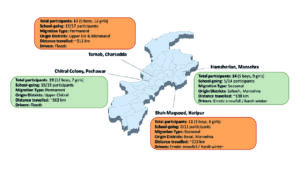
Data Collection: Fieldwork was conducted in November 2025 in four research locations in KP: i) Chitral Colony, Peshawar; ii) Tarnab, Charsadda; iii) Shah Maqsood, Haripur; and iv) Hamsherian, Mansehra.