
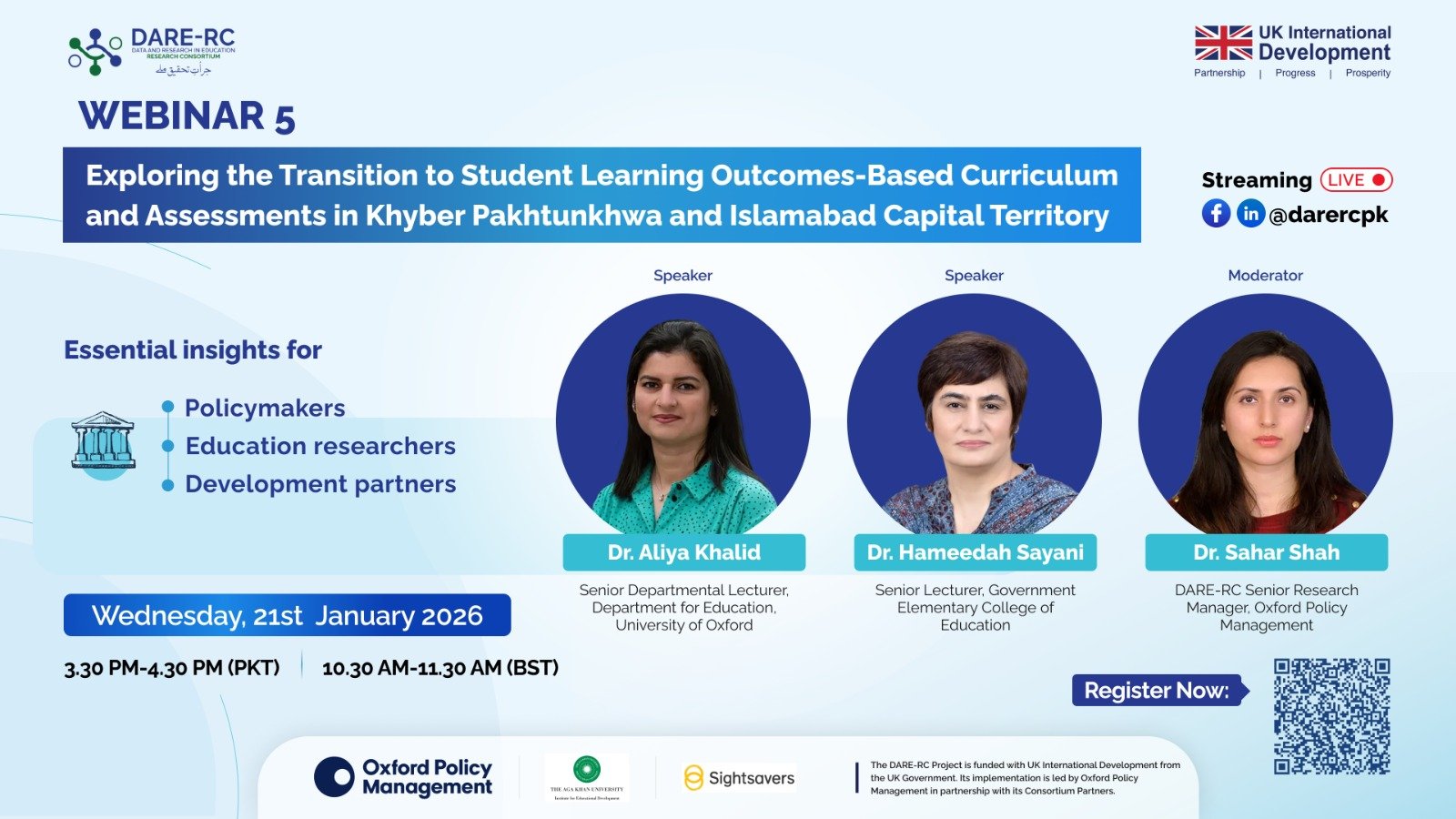
The Data and Research in Education – Research Consortium (DARE-RC) hosted the fifth session of its ongoing webinar series, ‘Building Communities of Practice in Education’, bringing together prominent education researchers from Pakistan and international institutions. The session focused on sharing key research insights and practical approaches to strengthening Pakistan’s education system. DARE-RC is an education research initiative committed to generating rigorous, policy-relevant evidence to inform education reform nationwide. The programme is implemented by Oxford Policy Management (OPM) in partnership with the Aga Khan University Institute for Educational Development (AKU-IED) and Sightsavers, with funding support from the Foreign, Commonwealth & Development Office (FCDO).
The webinar episode titled ‘Exploring the Transition to Student Learning Outcomes – Based Curriculum and Assessments in Khyber Pakhtunkhwa and Islamabad Capital Territory’ featured Dr Aliya Khalid, Senior Departmental Lecturer, Department for Education, University of Oxford, and Dr Hameedah Sayani, Senior Lecturer, Government Elementary College of Education. The session was moderated by Dr Sahar Shah, Senior Research Manager for the DARE-RC programme at Oxford Policy Management.
The webinar focused on how curriculum and assessment reforms are being implemented at the school level, drawing on preliminary findings from interviews with teachers and headteachers across KPK and ICT. The presenters highlighted that while Student Learning Outcome (SLO) -based reforms are well established in policy, their translation into classroom practice remains uneven and highly context-dependent.
During the discussion, Dr Aliya emphasised the need to stop assuming that curriculum and assessment reform automatically change classroom practice and also the assumption that teachers already have the skills to implement SLOs. Drawing upon comparative insights from ICT and KPK, Dr Hameedah illustrated how governance structures, professional development opportunities, and school-level capacities shape implementation experiences differently across regions. Findings from teacher and headteacher interviews pointed to persistent challenges, including curriculum overload, staffing gaps, and limited use of formative assessment to guide instruction.
In conversation with Dr. Sahar Shah, Dr Aliya highlighted the gap between international policy ideals and local classroom realities in the adoption of SLO-based education. While global literature often promotes outcomes-based education, its adoption in local contexts is frequently symbolic rather than substantive. The session underscored the importance of treating schools as the critical link between curriculum and assessment reform. recognizing teacher agency and headteacher instructional leadership as essential enablers of change. The effective use of assessment data for targeted instructional interventions was also identified as a key area for improvement.
The webinar concluded with reflections on lessons for policymakers, including redesigning teacher training using evidence-based models, strengthening pre- and in-service teacher education standards, and learning from provincial innovations such as Sindh’s teaching licencing. The presenters also highlighted the role of national institutions, including the Inter Board Coordination Commission (IBCC), in promoting cross-provincial coherence and shared learning.
The main crux of the discussion rested in the understanding that a system-level approach is necessary to propel the effectiveness of educational reforms.
This episode of the Building Communities of Practice in Education webinar series marks another important step in DARE-RC’s efforts to foster evidence-informed dialogue on education reform in Pakistan. By centring teacher and school-level perspectives, the session contributed to a deeper understanding of how curriculum and assessment reforms can be made more responsive, contextually grounded, and scalable across provinces.