
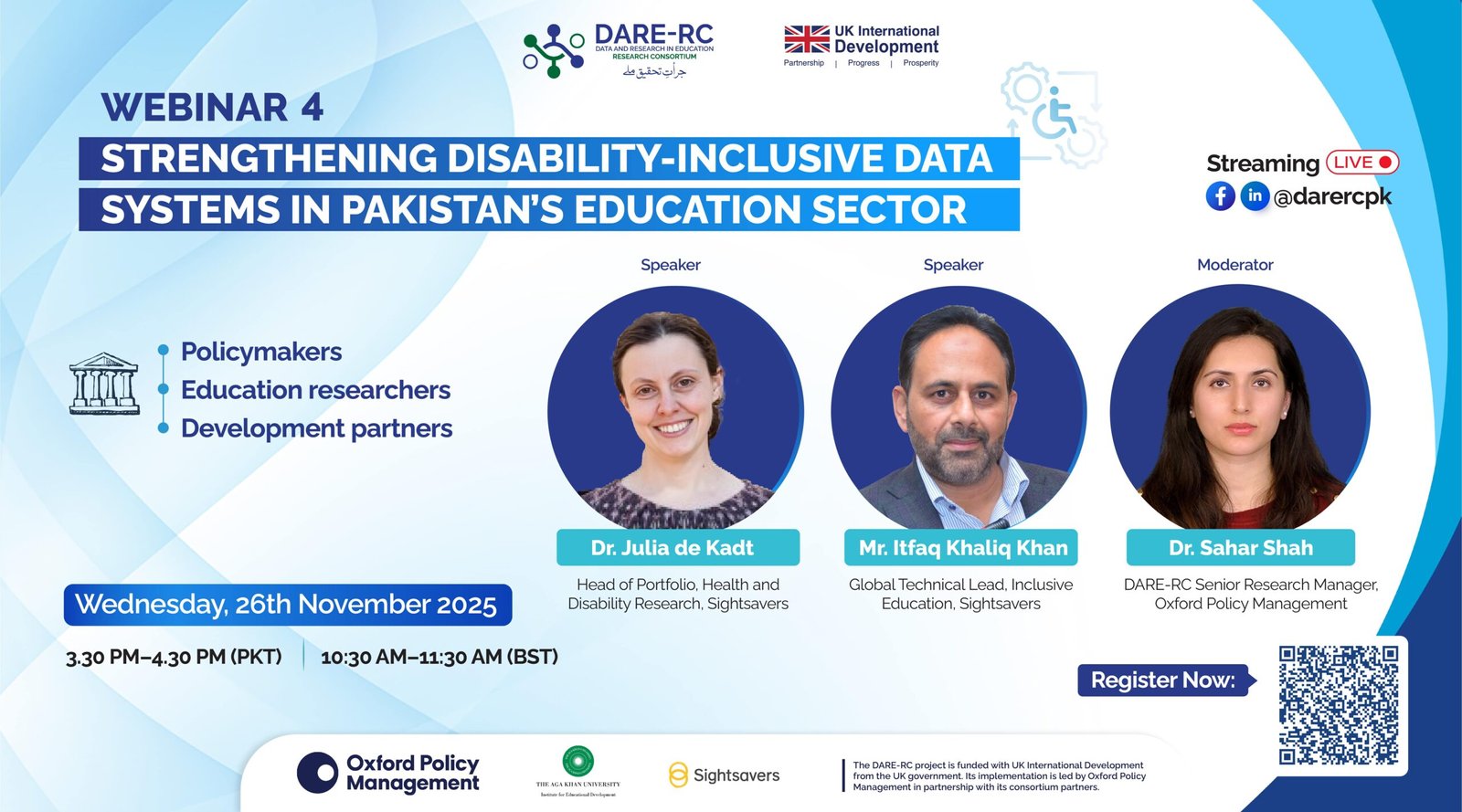
The Data and Research in Education – Research Consortium (DARE-RC) convened the fourth session of its webinar series, ‘Building Communities of Practice in Education’, bringing together leading education researchers from Pakistan and abroad to discuss key findings and share strategies for strengthening the country’s education system. DARE-RC is a pioneering education research initiative dedicated to producing actionable, evidence-based insights to support nationwide education reform. The programme is led by Oxford Policy Management (OPM) in collaboration with the Aga Khan University Institute of Education (AKU-IED) and Sightsavers, with funding from the Foreign, Commonwealth & Development Office (FCDO).
The webinar episode ‘Strengthening Disability-Inclusive Data Systems in Pakistan’s Education Sector’ featured Dr Julia De Kadt, Head of Portfolio, Health and Disability Research, Sightsavers, and Mr Itfaq Khaliq Khan, Global Technical Lead, Inclusive Education, Sightsavers. The session was moderated by Dr Sahar Shah, Senior Research Manager for the DARE-RC programme at Oxford Policy Management.
The webinar focused on the research objectives, methodology, substantive findings and policy recommendations emerging from Dr. Julia de Kadt’s DARE-RC study titled ‘Disability Inclusive Data Systems-An analysis of the Integration of the Washington Group Questions on Disability into the Annual School Census (ASC) in Pakistan’. Dr Julia De Kadt and Mr. Itfaq Khaliq Khan shared reflections on the process of integration of the four (of six) Washington Group Short Set (WG-SS) questions into the 2023/24 ASC. They highlighted the challenges as well as enabling factors in integrating the Washington Group Questions into the ASC.
Dr. Julia De Kadt shed light on the nature and quality of the actual data collected, as well as shared the responses of stakeholders at federal, provincial, and school levels in relation to training, data collection, analysis, and the use of disability-inclusive data. The study was guided by an adapted version of the World Bank’s SABER framework, which outlines four pillars of an effective EMIS—enabling environment, system soundness, data quality, and data use—emphasising continuous data collection and utilisation.
In discussion with Dr Sahar Shah (Senior Research Manager at DARE-RC), Dr Julia De Kadt and Mr Itfaq Khaliq Khan emphasized upon the use of a standardised tool, such as the WG-SS, along with adequate teacher training and clear data collection guidance help to reduce underreporting of numbers of children with disabilities. They stressed on the importance of recognising the significant achievements attained in the institutionalisation of disability data in the ASC and broader EMIS, and in awareness creation in relation to disability inclusion and inclusive education. Mr Khan further mentioned that following the approval of the Data Standardisation of Framework (DSF) in 2023, the Pakistan government has been working on strengthening data on the education system, including that for children with disabilities. The DSF includes four of the WG-SS questions i.e. seeing, hearing, walking and cognition. Dr Julia highlighted that the integration of the WG-SS within the DSF demonstrated strong commitment to collecting disability data.
The study adopted a sequential, mixed methods design, to explore the nature and quality of the disability data collected by Pakistan’s 2023/24 Annual School Census (ASC), and to understand the ways in which data collection processes, planning and implementation shaped the data collected. The study was conducted across the Islamabad Capital Territory (ICT) and all four provinces, with data collection in both urban and rural areas of Lahore, Karachi, Peshawar, and Quetta.
Following a mid-session question on the possible strategies that may be applied to create inclusive educational spaces for students with disabilities, Mr Itfaq Khaliq Khan emphasised on the fact that inclusive education is all about including everyone and not only about data and access to education. He commented that while the challenge is huge, the solution comes in three parts, namely access, participation of children in schools and improving their learning outcomes.
This session of the DARE-RC webinar series represents an important step towards promoting evidence-based education reform in Pakistan. By bringing key stakeholders into constructive conversation, the consortium furthers its goal of using high-quality research to inform policies that enhance collaboration across provinces and institutions.