
The Data and Research in Education – Research Consortium (DARE-RC) successfully hosted the latest session of its webinar series, Building Communities of Practice in Education, convening researchers, policymakers, and practitioners to explore practical, evidence-based solutions to improve middle school transition rates in Pakistan. DARE-RC is a pioneering education research initiative generating actionable insights to inform education reform nationwide. The programme is led by Oxford Policy Management (OPM) in collaboration with the Aga Khan University Institute for Educational Development (AKU-IED) and Sightsavers, and is funded by the Foreign, Commonwealth and Development Office (FCDO).
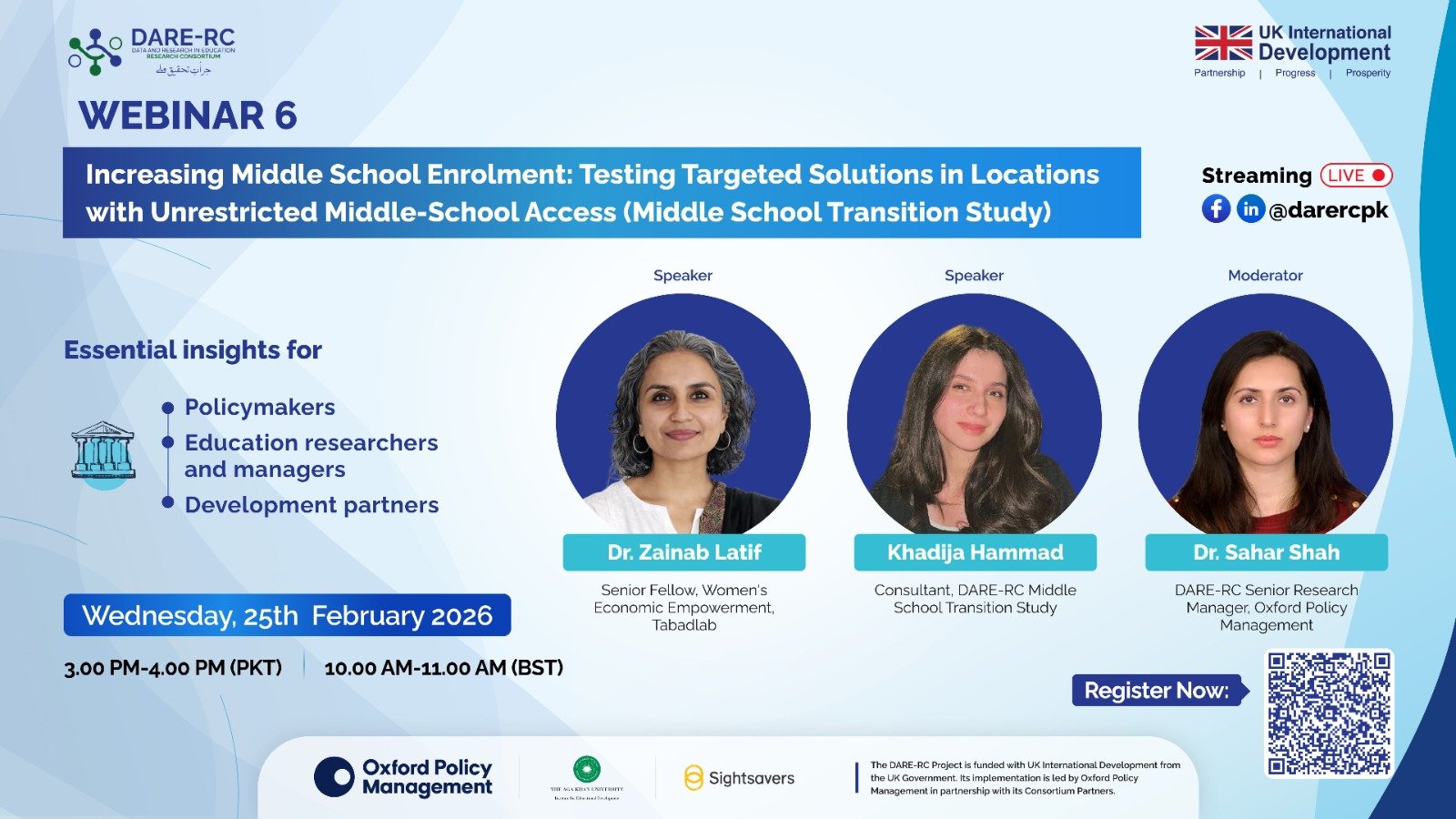
The webinar, titled ‘Increasing Middle School Enrolment: Testing Targeted Solutions in Locations with Unrestricted Middle-School Access,’ featured Dr. Zainab Latif (Senior Fellow, Women’s Economic Empowerment, Tabadlab) and Khadija Hammad (Consultant, DARE-RC Middle School Transition Study) and was hosted by Dr. Sahar Shah, Senior Research Manager at DARE-RC.
The session focused on one of Pakistan’s most persistent education challenges: the transition bottleneck between primary and middle school. As highlighted by Dr Zainab, ‘Transition, not access alone, is the critical system failure.’ The presenters further noted that gender disparities widen at the post-primary level, with girls disproportionately affected by dropout trends.
A central component of the intervention involved targeted communication strategies. The findings, as explained by Khadija, demonstrated that phone calls were significantly more effective than written materials such as SMS or pamphlets, particularly in rural settings where literacy levels vary. The use of local language (Punjabi) further strengthened engagement and parent recall. While the intervention produced measurable gains, the presenters however cautioned that ‘Behavioural nudges work best when they unlock an already feasible action and do not replace structural support.’ In a mid-session poll, a majority of the participants identified parents with high motivation but low capability, as those most likely to benefit from a behavioural nudge. The result reinforced the study’s central finding that many families are willing to transition their children to middle school but require practical, targeted support to navigate the enrolment process effectively.
In discussion with Dr. Sahar Shah, the speakers emphasised the importance of repositioning middle school transition as a distinct policy priority rather than an extension of primary enrolment efforts. Policy recommendations included embedding low-cost assessment mechanisms to continuously test programme effectiveness, allocating specific budgets and monitoring checkpoints for transition, and strengthening coordination within School Education Departments.
This episode of the Building Communities of Practice in Education series highlights DARE-RC’s continued commitment to translating rigorous research into practical, scalable solutions. By bridging behavioural science and education policy, the webinar contributed to an evidence-driven dialogue on improving post-primary participation and reducing gender disparities in Pakistan’s education system.