
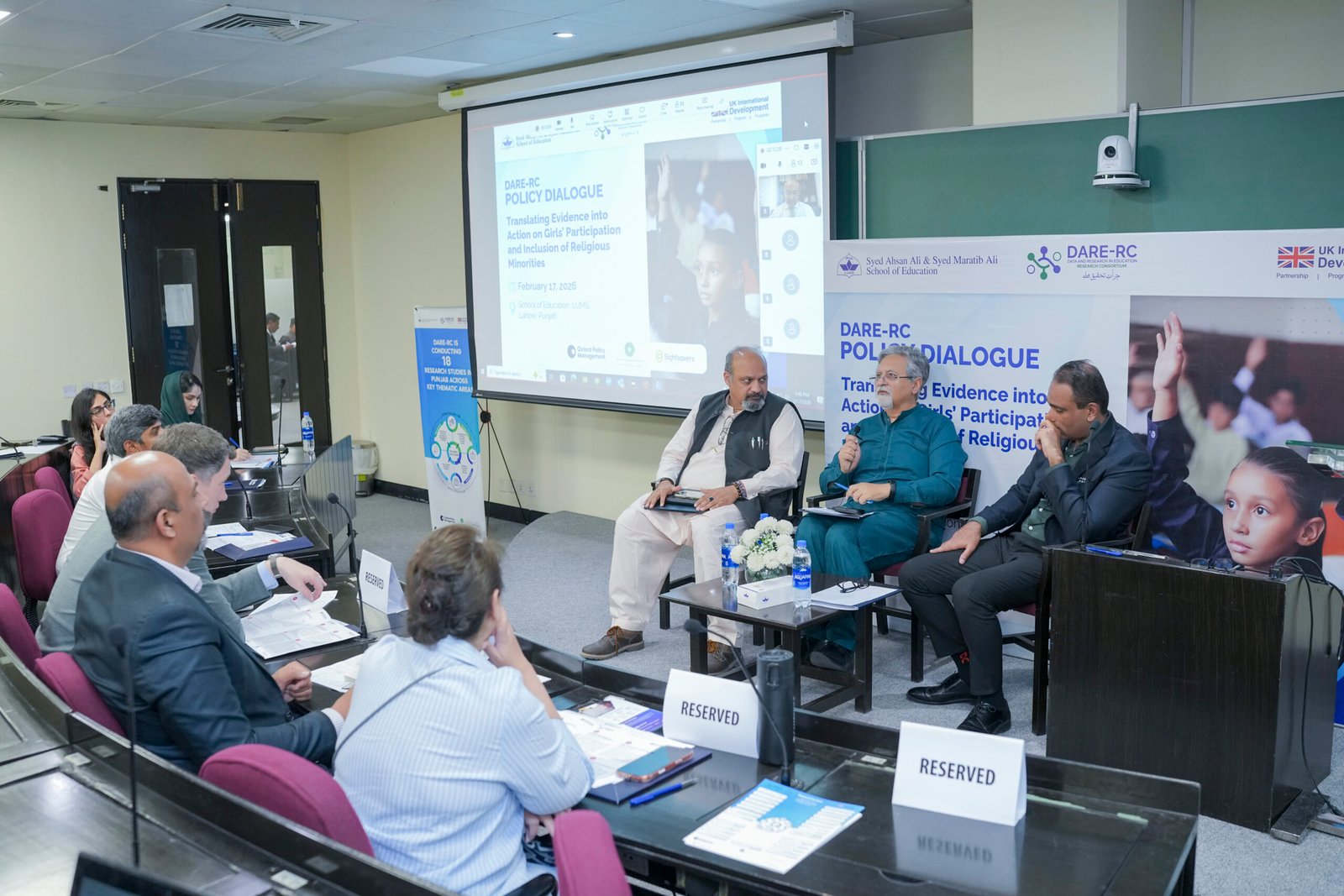
The Data and Research in Education – Research Consortium (DARE-RC) in collaboration with the School of Education (SOE) at the Lahore University of Management Sciences (LUMS), successfully convened its 3rd Policy Dialogue here in Lahore.
This dialogue is part of an ongoing series jointly led by DARE-RC and LUMS aimed at embedding high-quality education research into policy conversations. By convening structured, policy-facing discussions, the series seeks to promote evidence-informed decision-making and strengthen collaboration across stakeholders.
Titled “Translating Evidence into Action on Girls’ Participation and Inclusion of Religious Minorities,” the dialogue focused on translating findings from two DARE-RC studies into actionable policy insights. These studies explored persistent barriers to girls’ continuation at the middle-school level—even in areas where physical access to schools exists—and examined the lived educational and social experiences of children from religious minority backgrounds.
Speaking at the event, Ben Warrington, Head of the British High Commission Office in Lahore (FCDO) reiterated the commitment to evidence-based reform. He stated “Strengthening an education system takes an entire ecosystem, and collaborations like these reflect a shared commitment to transforming education reform.” Concluding, he emphasized, “It is crucial to link rigorous research to policy action and practical decision-making,” encouraging participants to engage critically and sustain this collective commitment to reform.
In her remarks, Dr. Tayyaba Tamim, Dean of the LUMS School of Education, emphasized the importance of integrating evidence into education system reforms. She stated, “At the School of Education, we are committed to creating a transformative space within education, and that cannot happen without sustained dialogue between the development sector, government, and researchers to see how research insights can be translated into meaningful policy.” She also highlighted the need for a nuanced understanding of the education sector, particularly regarding girls’ education and the lived realities of minorities, which must guide efforts toward a just and equitable society.
Dr. Ibtasam Thakur presented findings from the study on children from religious minority backgrounds, documenting how school climate, discrimination, and social exclusion shape participation and learning experiences. This research offers recommendations to strengthen inclusive education policies, teacher preparation, curriculum discourse, and school governance frameworks.
Dr. Zainab Latif shared insights from the study on increasing middle-school enrolment for girls, identifying demand-side and system-level barriers that contribute to dropout despite school availability. The study tested targeted interventions and generated practical recommendations relevant to stipends, retention strategies, and gender equity programming.
The presentations were followed by an interactive panel discussion including Mudassar Riaz Malik, Secretary of School Education Department Punjab, Dr. Irfan Muzaffar, Dr. Faisal Bari, Dr. Zainab Latif, and Dr. Ibtasam Thakur. The dialogue explored critical policy questions such as girls drop out despite physical access, policy levers for improving retention and learning, education systems response to the children from religious minority backgrounds, and adjustments to teacher training, school management, and accountability systems to advance inclusion alongside learning quality.
Participants including academia, development professionals, and government officials engaged in discussions on the importance of coordinated reforms, institutional accountability, and sustained collaboration between academia and government.
Mudassar Riaz Malik highlighted the operational need of research-policy collaboration. Reflecting on the discussion, the Secretary of the School Education Department emphasized, “This policy dialogue is extremely important for us. We need to ground this discussion in evidence.” He noted that while all the gaps highlighted are important, and the system must move toward evidence-based policymaking, not policy-based evidence-making.” He stated that “The problem is not always policy, sometimes it is structural and there is a need to convert policy recommendations into concrete action plans.”
As Pakistan continues to address challenges related to learning outcomes, gender equity, and inclusion, platforms such as this dialogue play a critical role in ensuring that research moves beyond publication and contributes directly to shaping practical, context-responsive reforms.
The DARE-RC program is being implemented by Oxford Policy Management (OPM) in partnership with the Aga Khan University Institute for Educational Development (AKU-IED), and Sightsavers, and is funded by the UK Foreign, Commonwealth and Development Office (FCDO).
The Syed Ahsan Ali & Syed Maratib Ali School of Education at the Lahore University of Management Sciences (LUMS) is committed to advancing scholarship, leadership, and policy engagement in education.