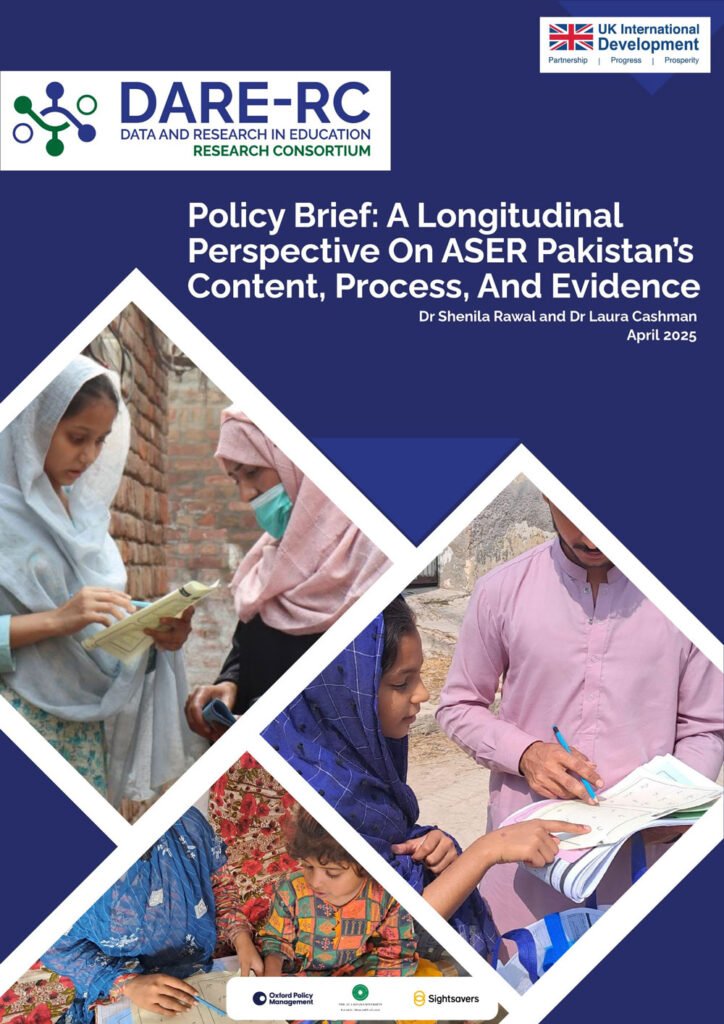
A Longitudinal Perspective On ASER Pakistan’s Content, Process, And Evidence
Dr Shenila Rawal & Dr Laura Cashman
Summary
The Data and Research in Education-Research Consortium (DARE-RC) aims to understand the challenges facing Pakistan’s education system and expand the existing evidence base that explores potential solutions to these issues. Evidence developed under DARE-RC is made publicly available and shared with a range of stakeholders, including government partners, to improve education service delivery in Pakistan. The consortium undertakes three main activities to support these aims: strengthen the accessibility of high-quality research on what works to improve education, promote in-country research capacitybuilding, and enhance stakeholder engagement, communication, and dissemination of findings in Pakistan. This report contributes to all three of these activities by presenting a detailed scoping review of the Annual Survey of Education Report (ASER) Pakistan’s past and planned activities.
ASER Pakistan, established in 2009 (following a pilot phase in 2008), is the largest citizenled household-based survey in the country. The survey measures a diverse range of indicators related to educational access, quality and learning outcomes, ultimately exploring the fundamental question: “are our children learning?” (ITA, 2025). ASER Pakistan was inspired by the success of ASER India’s citizen-led assessment model, first implemented in 2005, which also measures children’s basic reading and numeracy skills. It has since been linked to other initiatives such as UWEZO in East Africa and Medición Independiente de Aprendizajes (MIA) in Mexico through the People’s Action for Learning (PAL) Network, a collective working to improve learning outcomes worldwide. As ASER Pakistan matures and evolves, understanding the scope, methods and uptake of the survey will be important to assess past impact and identify opportunities for improvement. This report explores these key areas, situated within the global context of similar and contrasting assessment efforts, to highlight key achievements, past challenges and potential ways forward for ASER Pakistan.
The report on which this brief is based covers content, processes, dissemination uptake and complementarity of ASER Pakistan.