
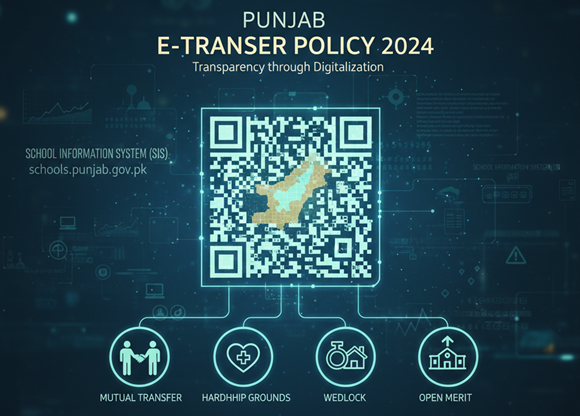
Punjab e-transfer policy core categories
The e-Transfer policy
As the new school year starts in Pakistan’s Punjab province, we are reminded of teachers’ paramount role in imparting high-quality education and in creating an environment conducive to learning. Any teacher-related policy reform therefore offers an opportunity to improve the persistent low educational achievements of the majority of children in Pakistan.
The Punjab teacher e-Transfer policy introduced an online application system in 2019 to make teacher transfers transparent and merit-oriented as compared to the earlier less efficient paper-based system. By applying clear rules and criteria for relocation, the policy aims to balance teachers’ needs with system requirements contributing to better learning outcomes.
The e-Transfer study
Our study analyses administrative data on transfers that took place over a period of five years (2019-2024) and conducts interviews with teachers, head teachers and district officials to assess the impact of the e-Transfer policy on teacher satisfaction, imbalances in regional teacher distribution and school outcomes. Preliminary results from interviews indicate that teachers face lower transaction costs for transferring under the new policy. Teachers and administrators appreciate the efficiency of digital technology and the greater transparency in teacher placement decisions.
Figure 1 – Reproduced from Michie et al, 2011
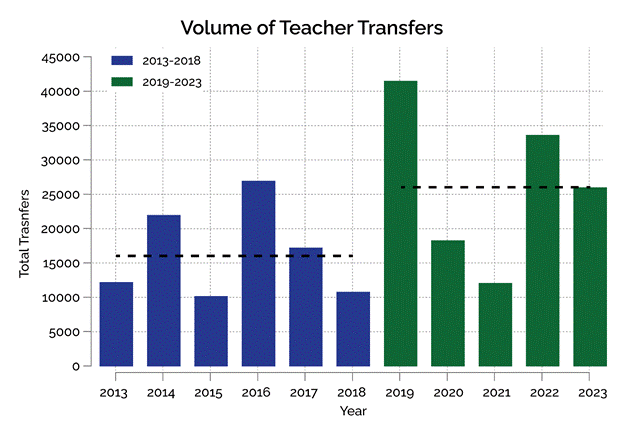
Source: Annual School Census, 2013-2023
The overall volume of teacher transfers has increased after 2019 due to the reduced transaction costs of applying. In addition, transfer data shows large movements of teachers from rural and primary to urban and high schools, and a district official said that there may have been a movement of teachers from “needy to surplus schools”. A head teacher in an urban high school described the disruption caused when teachers announce their intention to transfer while school is in session rather than during summer break. Despite many positive features, an inadvertent negative consequence of the policy may be that rural students, especially in primary schools incur greater academic losses than their urban counterparts if too many teachers transfer out of rural schools. Management systems continue to prioritise seniority for transfers and this may be a reason for the worsening equity outcomes.
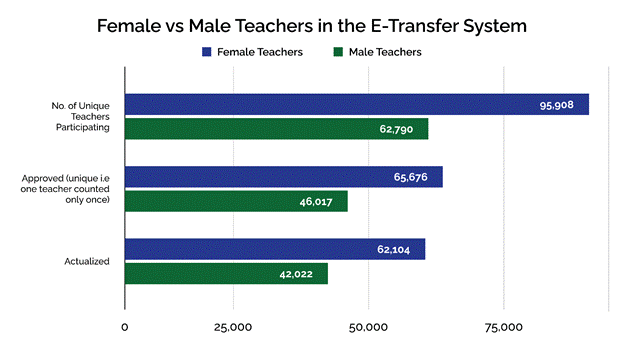
Figure 2 – More female than male teachers participated in the e-Transfer system
Source: e-Transfer data, 2019-2024
Interviews with head teachers, teachers and government officials suggested that greater transparency and ease of application under the new e-Transfer policy especially allowed female teachers greater access to preferred transfer options, unlike the earlier system that required connections, incurring expenses for required paperwork and greater mobility to travel to central government offices, all of which were relatively more difficult for female teachers. One teacher mentioned that she “joined the school easily with the QR code” upon receiving the transfer. Another teacher expressed her satisfaction with the online application process and the automatic generation of transfer orders and that she could “get all of this done while sitting at home”.
A female district official mentioned how the “wedlock category under e-Transfer presented a convenient way for female teachers to apply online to move to preferred locations to join their spouses”.
Figure 3 – Rural primary schools are most likely to be adversely impacted from teacher transfers
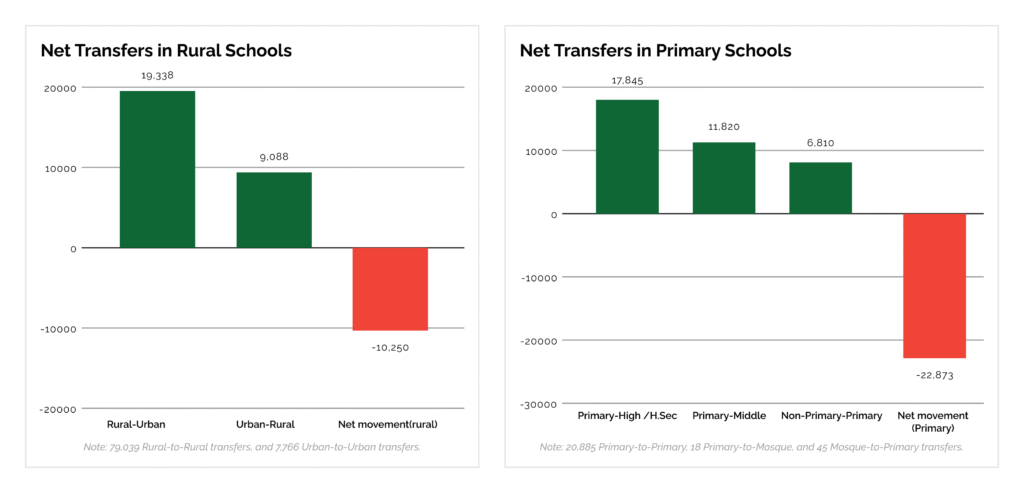
Note: Of the 22,873 teachers that move out of primary schools, roughly half (10,841) move due to promotion.
Despite the e-Transfer policy rule of teachers not being allowed to move out of schools with two or less teachers, a significant movement of teachers took place from rural to urban schools, and from primary to high schools. A district official felt, “the reason for teachers moving from rural primary schools is that the workload is greater there, with fewer teachers, at most 2-3 and up to 6 classes; while in a high school, there are more teachers and less monitoring by education officers.”
While teachers transferring out is problematic, a headmaster in rural central Punjab also noted that, “the incoming teachers may turn out to be a better fit; therefore, it is hard to predict if rural schools are better or worse off from this trend.”
The problem, however, is that new teachers are slow to join rural schools and prefer transferring to cities. According to a district officer, “The teacher is satisfied. The drawback is, obviously, to the department. Teachers mostly move to the urban areas, the rural areas become deprived, and the department does not have any immediate hiring option – those schools suffer, and the children suffer.” One special education teacher mentioned that, “she felt adverse leaving her students without a relevant replacement after moving out of a rural school, and how the students’ mothers still reach out to her.” Additionally, teachers, head teachers, assistant education officers and deputy district education officers mentioned how some schools with insufficient teachers are being handed over to the Punjab Education Foundation or “PEF” after too many teachers transferred out, creating a shortage of subject teachers. Parents tend to take their children out of school if too many teachers transfer out.
Teacher movement to avail promotion opportunities shows a small net gain for rural schools
About half of the teachers moving out of primary schools are due to promotions representing a net gain for rural schools. Teachers must avail promotion within a year otherwise they lose the opportunity. An interviewee mentioned, “if teachers can’t get adjusted, their promotion may lapse. And the one who has been promoted wants to take up the next scale right away, and have the permission to move, and they should.” During visits to rural schools, the research team met at least two teachers who had moved only to get their promotions, and their intention was to transfer back to an urban area as soon as an appropriate post opened in the next transfer round.
It takes a long time to replace teachers transferred from rural primary schools
Interviews revealed that teachers often left during the school year and that there was no automatic system to fill posts left vacant by transferred teachers. Data shows the number of months a post remains vacant after transfer, and interviews also shed light on how schools avoid disrupting students’ learning progress in the classroom. Preliminary results indicate that it can take up to 16 months for primary teachers to be replaced in a school where a teacher has transferred out. Rural primary schools may be left without sufficient teachers for extended time periods (of up to a year on average for both male and female schools), signifying substantial learning losses for students.
Measures taken by schools when teachers transfer out without timely replacements
Interviews with teachers, head teachers and district officials revealed that when transferred teachers are not replaced quickly, students tend to drop out, or schools with transferred-out teachers may be turned over to joint partnerships with private or non-governmental organizations such as “PEF” (Punjab Education Foundation Schools). To counter this trend of school closures, some schools recruited teacher interns under the School Teacher Internship Program (STIP) though an urban area district officer expressed dissatisfaction with the short-term nature of the appointments. Several head teachers mentioned informal hiring of local teachers at low stipends as a stopgap measure, mostly funded by head teachers’ and teachers’ personal contributions. Discretionary school budgets were usually insufficient for hiring local teachers.
Conclusion

The Punjab e-Transfer reform successfully moved thousands of teachers to their preferred locations and posts. Teachers and education officials expressed satisfaction with the modernized online transfer system for creating convenience, access and transparency in relocating teachers, especially female teachers. However, the e-Transfer policy needs to address the trade-off between retaining good teachers in rural schools versus maintaining high teacher satisfaction and welfare levels, as both factors affect students’ academic progress. Preliminary analysis of transfer data and interviews with teachers, head teachers and district officials show that transferred teachers’ positions are not filled for over a year on average, indicating substantial learning losses for students. These delays in replacing teachers remains a major challenge, sometimes resulting in school closures.
The e-Transfer system’s efficiency may have created an unmanaged “marketplace” that inadvertently accelerated teacher movement, hollowing out the already disadvantaged schools in the system. The challenge now is to combine the efficiency of going digital with developing policy to better define eligibility and merit for transfer, and to evolve the policy’s logic from a simple automation tool into a sophisticated workforce management system that is outcome focused. By strategically refining the rules of the system, we can steer this powerful engine to not only transfer teachers efficiently, but to effectively place our best teachers where they can make the greatest difference.
Authors: Dr. Masooma Habib: Fellow, Consortium for Development Policy Research (CDPR), Dr. Farooq Naseer: Assistant Professor, Department of Economics, Lahore University of Management Sciences, Lahore (LUMS), Dr. Yasira Waqar: Acting Dean, School of Social Sciences and Humanities, University of Management and Technology, (UMT) Lahore, Ayesha Irfan (Research Associate-DARE RC Study), and Omar Zahid (Research Associate-DARE RC Study)
Quality Assurance: Dr. Sahar Shah (DARE-RC Senior Research Manager)
References
Anzia, Sarah F., and Terry M. Moe. “Collective bargaining, transfer rights, and disadvantaged schools.” Educational Evaluation and Policy Analysis 36.1 (2014): 83-111.
ASER Pakistan. Annual Status of Education Report (ASER) Pakistan 2023: National (Rural). Idara-e-Taleem-o-Aagahi, 2024, https://aserpakistan.org/document/2024/aser_national_2023.pdf.
Bari, Faisal, et al. “An investigation into teacher recruitment and retention in Punjab.” Institute of Development and Economic Alternatives (IDEAS) (2015).
Beg, Sabrin, et al. “Engaging teachers with technology increased achievement, bypassing teachers did not.” American Economic Journal: Economic Policy 14.2 (2022): 61-90.
Programme Monitoring & Implementation Unit. Annual School Census Dataset (2013-2024).
Punjab Education Foundation. (2023). https://www.pef.edu.pk/Home/.
Punjab Information Technology Board (PITB). e-Transfer Dataset (2019-2024).
School Education Department, Government of Punjab. E-Transfer Policy. Punjab Schools (2024). STI Jobs. “STIs Portal Punjab School Teacher Interns 2025.” STI Jobs, Stijobs.pk, 24 Jan. 2025, https://stijobs.pk/stis-portal-punjab/