
Imagine a classroom; a busy, dynamic space where learning happens. Now, imagine the education system—the massive machinery of the state—standing outside that classroom.
For decades, the system had to guess what was happening inside. That changed in 2021, when the School Education Department (SED) Punjab, digitised monitoring and Continuous Professional Development (CPD) for public schools. Paper-based monitoring and face-to-face trainings were replaced by a technology-enabled ecosystem. This included the rollout of the digital Classroom Observation Tool (COT) through mobile applications to provide real-time pedagogical feedback, and the Innovative Teachers’ Support Package (ITSP), a modular online learning management system (Hennessy et al., 2022).
By digitising classroom observations and teacher development, the public-school system across Punjab effectively installed windows to see into classrooms and doors through which support could be delivered. Yet, a critical problem has emerged: while the system can now look through those windows, it is rarely able to open the doors to help.
To understand this dynamic, a mixed-methods study conducted in 2025—Digital Evolution in Teacher Development: Analysis of Punjab’s Continuous Professional Development (CPD) System—examined the implementation of this blended CPD model. The research analysed administrative data from over 136,000 digital classroom observations recorded between 2021 and 2024 and incorporated qualitative fieldwork across four diverse districts: Lahore, Rawalpindi, Multan, and Muzaffargarh.
The research findings reveal a clear gap between policy intent and on-ground implementation. The infrastructure has been built (the windows and doors exist), but the flow of information is often one-way, burdensome, and disconnected from the realities of teaching and learning. Data flows efficiently upwards, involving collection at the school level and collation and presentation at the provincial secretariat. However, support and insights struggle to flow back down.
This disconnect divides teachers’ and mentors’ attention between meeting compliance-driven reporting needs and improving instructional practice. At the same time, the data systems themselves offer little targeted support for improving classroom practice (Aslam et al., 2022).
This blog explores this digital bottleneck. Drawing on the recent CPD research study, it maps the current information flows, highlights the successes of peer-to-peer collaboration, and proposes a way forward: connecting the observation window directly to the training door so as to translate data into meaningful action.
The Clerical Burden of Teachers and Mentors
Punjab’s education system operates through a vast hierarchy that stretches from the provincial secretariat down to individual teachers in classrooms. Policies and priorities are set by the School Education Department (SED) and passed down to the District Education Authority (DEA). Within districts, Chief Executive Officers (CEOs), District Education Officers (DEOs), and Deputy District Education Officers (DDEOs) manage implementation, while Assistant Education Officers (AEOs) work directly with schools by mentoring teachers and reporting school-level information upwards.
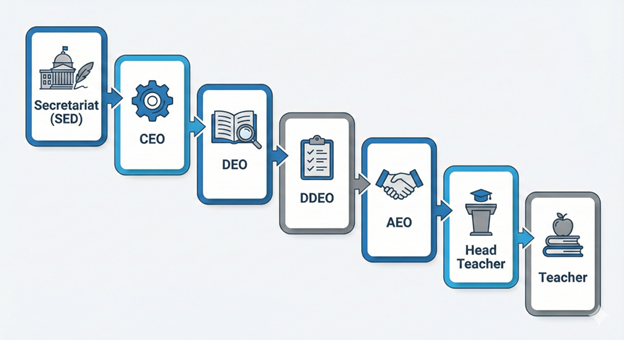
Figure 1: SED Punjab Hierarchy
Ideally, information flows smoothly both upward and downward through this system to facilitate policy, planning, and classroom practice. Digitisation efforts were intended to make this easier. The automation of AEO observations through the COT App and the introduction of online, on-demand professional development were designed to further enhance the flow of data across the system. However, in reality, digitisation, has often increased pressure without reducing workload. While it has created an efficient channel for sending data upwards for monitoring, it has not yet created a strong feedback loop that uses data to provide timely and relevant support where it is needed most (Crouch & DeStefano, 2017).
Research participants described a Downward Flow characterised by directives and immediate demands. One participant noted, “The information required by the Secretariat has to be provided immediately.” This urgency to respond quickly often compromises accuracy of information.
As a result, data collection is often perceived more as a burden than as a useful tool for informed decision-making. Many teachers and Assistant Education Officers feel they are engaged in clerical work rather than educational leadership. When the focus is entirely on uploading photos, ticking boxes, and syncing apps, the actual goal of improving classroom instruction is lost. The data becomes a compliance metric, not a window into student learning.
Figure 2 (below) illustrates these flows. It highlights the tension between the formal vertical hierarchy (downward and upward flows) and the informal support networks (horizontal flow) that teachers rely on. While the vertical channels often carry directives downward and data upward, the horizontal channels represent peer collaboration among teachers to navigate these demands.
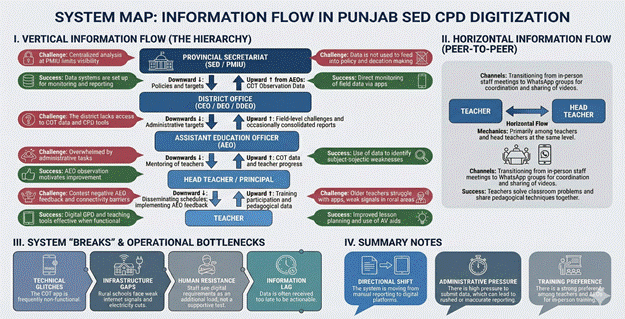
Figure 2: The System Map illustrates the complex web of information flow highlighted in the research findings.
The Data Silo Problem
Perhaps, one of the most significant challenges identified is the upward flow of data, which often disappears into a black hole. Data is collected digitally from the field, including classroom observations, attendance records, and training completion, and is automatically sent to the central database at the Programme Monitoring and Implementation Unit (PMIU). However, this data rarely flows back in usable form to the people who collect it, despite recent efforts to develop multi-tiered data dashboards for district officials (Mugo et al., 2022).
District officers (DEOs and DDEOs) reported limited visibility into the very data their teams collected. As one respondent highlighted, “District leadership gets COT scores only in presentations.” They cannot verify this information in real-time or use it to make quick, local decisions.
This creates a paradox: the system is data-rich, but information-poor. Millions of data points exist, but synthesising them into actionable evidence for decision-making, especially at the district and tehsil levels, remains a struggle.
The Missing Link: From Observation to Action
Currently, there is a risk that the data collected through the COT window is merely recorded, stored, and forgotten, or it is used solely for punitive monitoring (Jamal et al., 2024). This suggests a missed opportunity. Observation data could instead be used to inform, refine, and strengthen the support provided through the CPD channel.
Rather than relying on a one-size-fits-all training approach, the system has the potential to use observation data to customise professional development to specific needs. For example, if COT data reveals that a teacher is struggling with student engagement, or that a school demonstrates weak performance in science instruction, CPD support could be automatically adjusted to meet those needs.
Data should not just function as a report card; it should be a prescription. By linking the observation tool directly to training modules, the system can move from generic professional development to more targeted and responsive support at the level of schools and individual teachers (Adoho & Blimpo, 2021).
Opening the Door for Support: Success Stories
Despite these challenges, the research highlights several areas where the system is working effectively. When the focus shifts from policing teachers through the window to supporting them through the door, the digital tools shine.
1. The Power of Horizontal Flow-Peer Collaboration
While vertical communication within the system is often constrained by top-down directives, horizontal collaboration among teachers is emerging as a strength. Teachers are using informal digital channels, such as WhatsApp groups, to discuss instructional challenges and share solutions. One teacher noted “If there is a problem in class, our entire staff sits together and solves it.” This peer collaboration is a success story. It shows that when teachers have access to data and own the communication, they actively use these channels to drive improvement.
2. Immediate Feedback Loops
When digital tools are effectively implemented in the classroom, they can transform the relationship between the AEO and the teacher. The research found that timely feedback from the Classroom Observation Tool (COT) can be a powerful motivator. Instead of waiting months for a paper report to be generated, teachers can review observation feedback instantly. This transparency ensures that the window is not just for surveillance but a tool that encourages reflective practice, constructive dialogue and continuous improvement among teachers.
3. The Organic Demand for Data
Perhaps the most encouraging finding is the growing appetite for on-demand data among district level officials. Staff involved in implementation is not rejecting data; rather, they are seeking greater access to it. Instead of using data merely to meet reporting requirements. they want to track their own performance metrics and use them to improve practice. As one participant emphasised, “We should be able to see data directly, rather than wait for consolidated reports,”
Conclusion: From Monitoring to Mentoring
The digitisation of education in Punjab has successfully built the infrastructure. The windows of observation and the doors of development are now in place. The challenge is how these tools are utilised.
If observation systems such as the COT window are used only for upward reporting—to monitor and demand data—teachers and AEOs risk being burdened with data entry. However, if the CPD door is used to pass meaningful evidence and insights back to the classrooms, to facilitate peer collaboration, reflection, and provide targeted actionable support, the system has the potential to be genuinely transformed.
The evidence is available. The infrastructure already exists. The next step is to ensure that the information flowing across the system does not only travel upwards to a dashboard but also flows back to the classroom, where it matters the most.
Acknowledgement: The authors would like to thank Dr. Irfan Muzaffar for his analogy of the system entering the classroom through five doors, presented at the DARE–RC Summit 2025.
References
Adoho, F., & Blimpo, M. P. (2021). Improving education outcomes through data use: Evidence from Sub-Saharan Africa. World Development, 145, 105527.
Aslam, M., Rawal, S., & Kingdon, G. G. (2022). Systemic barriers to using education data for decision-making in Pakistan. Compare: A Journal of Comparative and International Education, 52(7), 1094–1111.
Crouch, L., & DeStefano, J. (2017). Doing reform differently: Combining rigor and practicality in system reform. RTI Press.
Hennessy, S., D’Angelo, S., McIntyre, N., Koomar, S., Kreimeia, A., Cao, L., Brugha, M., & Zubairi, A. (2022). Technology Use for Teacher Professional Development in Low- and Middle-Income Countries: A systematic review. Computers and Education Open, 3, 100080.
Jamal, N., Gull, K., Khan, M. T., Ahmad, Z., & Khan, M. A. (2024). Systematic Barriers to Effective School Monitoring In Pakistan: The Perspective of Assistant Education Officers (AEOs). Migration Letters, 21(S10), 1379–1390. Mugo, J., Orodho, J. A., & Nampota, D. (2022). From data to decisions: Educational management information systems and teacher professional development in East Africa. Educational Management Administration & Leadership, 50(5), 801–820.