
In May 2024, Pakistan’s Prime Minister declared a national emergency over something that doesn’t make headlines the way a flood or an earthquake does. Pakistan has 25 million children out of school, and Learning Poverty — the percentage of 10-year-olds who cannot read and understand a simple text — sits at 79%. In Sindh, the picture is sharper still: only 4.5% of Grade 3 children can read in Urdu/Sindhi, and 9.1% can solve basic arithmetic divisions. These are not new facts to anyone working in Sindh’s education sector. What is new is that the province has now implemented an internationally acclaimed, pedagogical model that can reverse these facts — and its government intends to integrate this teaching model within the education policy and scale it. that has already a solid policy in place (2024) and said yes to scaling it.
What was tested, and where?
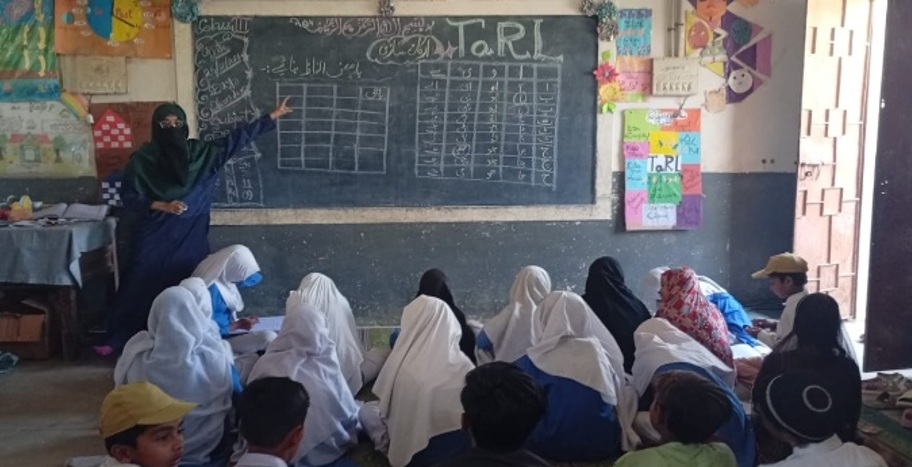
Between early 2025 and May 2026, the Sindh’s School Education & Literacy Department (SELD) in partnership with Idara-e-Taleem-o-Aagahi (ITA) and the FCDO funded-DARE-RC Programme (implemented by OPM Pakistan), piloted Scaling TaRL Through Mainstream Systems — a system embedded initiative built to answer one specific question: can Teaching at the Right Level (TaRL), be absorbed into the government system , using government teachers within existing structures and infrastructure?
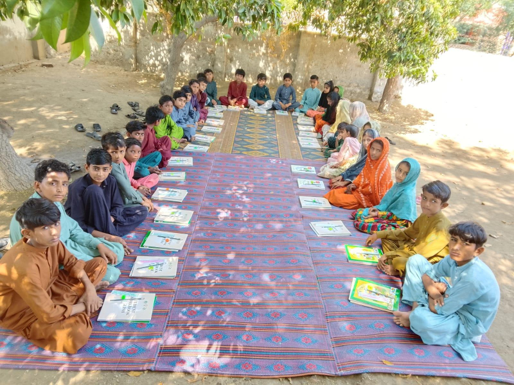
The pilot was deliberately designed to stress-test that question across two very different realities. One district, Karachi West, brought urban density, high migrations, and a multilingual student population. Umerkot brought a rural, low-resource, Sindhi-medium, majority-Hindu, a border district with some of the weakest baseline indicators in the province. Across both, 223 schools were onboarded, 62 SELD, Provincial Institute of Teacher Education (PITE) nominated Master Trainers were trained, and over four cohorts of students (46% girls), 472 trained teachers ran 60-day TaRL camps that reached 20,128 children..
Reaching every child: what it reveals about geography and gender
Rural Umerkot didn’t just keep up, it pulled ahead
Karachi West and Umerkot could not have started from more different places. Karachi West is a dense, high-migration urban district of roughly 768,600 school-age children, with 39% out of school. Umerkot is a rural, desert-border district of about 387,800 school-age children — smaller, but far more excluded, with 54.9% out of school, and only 36.3% of children holding a birth registration.
Given that gap, Umerkot might reasonably have been expected to trail. Instead, by endline it matched or outperformed Karachi West on every advanced-learning measure:
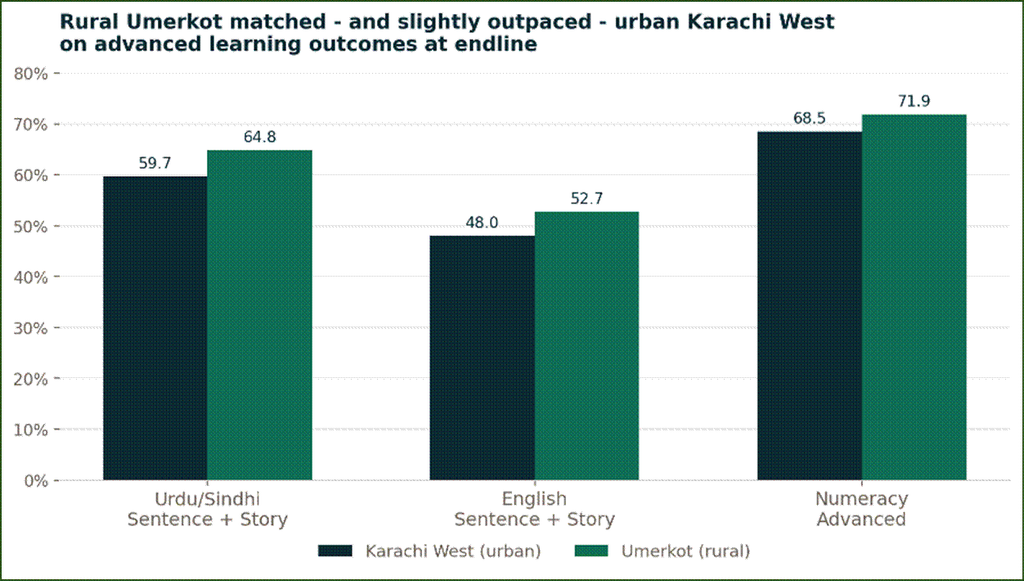
Figure 1. Karachi West vs. Umerkot, advanced-band endline outcomes by subject.
Umerkot reached 64.8% combined Sentence-plus-Story reading in Urdu/Sindhi against Karachi West’s 59.7%, 52.7% against 48.0% in English, and 71.9% advanced numeracy against 68.5%. Karachi West held a narrow edge only at the very top Story-only band in both languages — plausibly a reflection of greater urban print exposure — but Umerkot converted more children overall into competent readers and problem-solvers. That’s a strong signal for scale-up: the model’s impact isn’t propped up by urban infrastructure or advantage. It worked hardest in the district that needed it most.
Girls vs. boys: comparable gains, with girls slightly ahead in literacy
The pilot reached 10,884 boys (54%) and 9,244 girls (46%) — a healthy, balanced split. Both groups saw advanced-proficiency rates roughly quadruple to quintuple over a single 60-day cycle, with a modest divergence by subject:
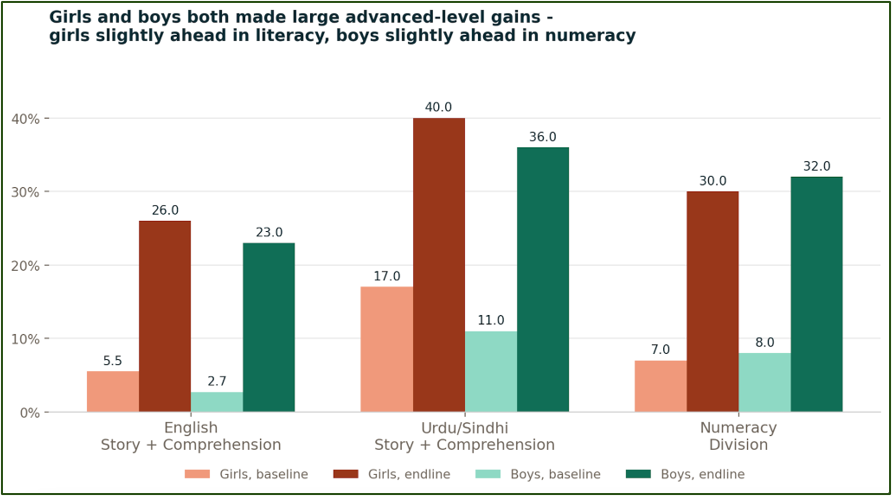
Figure 2. Girls vs. boys, baseline-to-endline advanced-band outcomes by subject.
In English, girls moved from 5.5% to 26% at the Story and Comprehension level, ahead of boys’ 2.7% to 23%. In Urdu/Sindhi, girls again edged ahead, from 17% to 40% versus boys’ 11% to 36%. In numeracy, the pattern flips modestly: boys reached 32% at Division level against girls’ 30%, up from 8% and 7% respectively.
None of these gaps suggest that the model favours one gender over the other structurally — both saw dramatic, comparable improvement. If anything, girls’ slightly stronger literacy gains are a notable finding in a context where girls’ reading outcomes nationally tend to fall further behind the longer they stay in school. For a province actively working to close gender gaps in foundational learning, this is evidence that TaRL’s design is gender-equitable in practice, not just in intent.
| Geography and gender are two of the most common fault lines along which education interventions quietly underperform — working well in easy contexts and for advantaged groups, less well elsewhere. This case shows neither fault line opening up here. That consistency, across a rural border district and an urban migrant settlement, across girls and boys alike, is exactly the kind of evidence a province-wide scale-up case needs. |
One of the main findings is that not only have scores improved,they have changed in a manner that has led to a redistribution of children out of the lowest learning bands and into fluent, functional literacy and numeracy. This finding has been validated independently by DARE-RC’s research team led by researchers from the University of Cambridge, Iqra University and AMBA UK that is working on the evaluation of the Sindh TaRL implementation project.
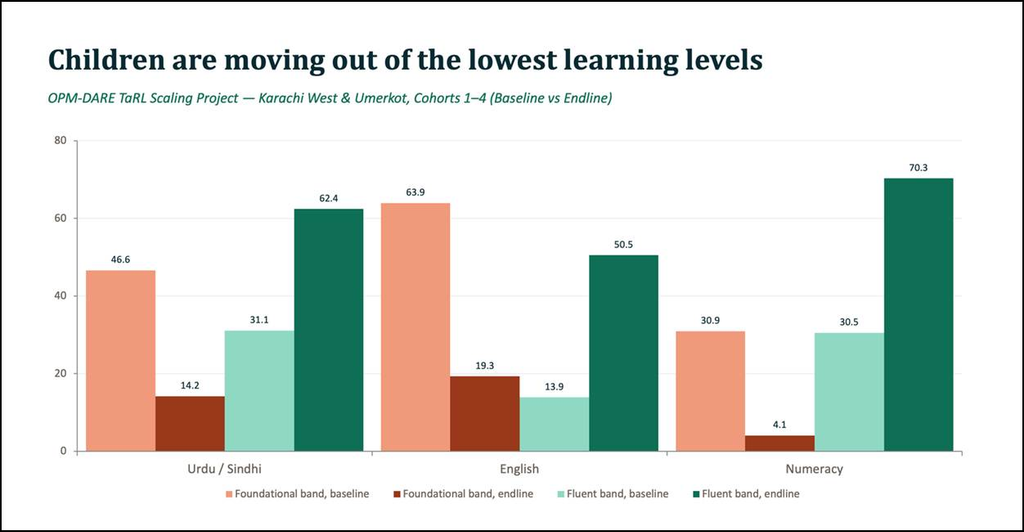
Figure 3. Overall results showing a decline in beginner levels (red) and a rise in advanced levels (green).
By endline, roughly two-thirds of assessed children were reading connected text in their local language, and an estimated 14,158 learners — more than double the baseline figure of about 6,136 — could perform subtraction or division.
Teacher voices
Ms. Sonia Kanwal (Primary Section Head, EAB GBHS Orangi No. 10, Karachi West) — on TaRL as a system-level shift:“This intervention has changed our perspective. It focuses squarely on foundational learning, giving students a chance to pace up and achieve academic success. I advocate for training more of our staff in this student-centered approach to enhance foundational skills across all primary
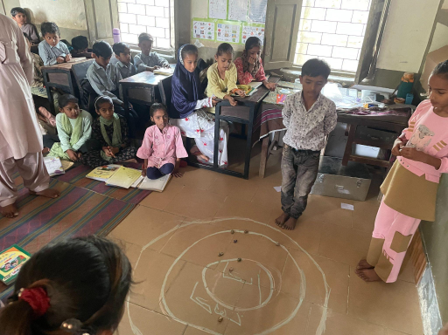
Shazia Naz (GBPS Orangi, Karachi West, 16 years’ experience) — on why math specifically needed TaRL:
“Other subjects often have activities to engage children, but mathematics is more abstract. The lack of play-based activities failed to capture the children’s attention and made concepts difficult to understand, especially in a classroom of mixed learning levels.”
Kishwar Sultana Farooq (GBPS Madina Sabri Chowk, Karachi West, 20+ years’ experience) — on misjudging a student before TaRL:
“I thought she was a slow learner and an introvert with no class participation.” [Baseline assessment showed Eshal Imtiaz was actually at story level in Urdu.]
Many more stories such as the above highlight the transformation that took place among teachers and students alike,
On the discomfort of letting go of control:
“My confidence was tied to my control of the classroom. The idea of students leading activities, of learning through play, felt unfamiliar and risky.”
On what shifted:
“The most significant change was the transfer of leadership. In traditional practice, I was the only one ‘doing.’ Now, I guide while students explain rules to peers, demonstrate steps in Letter Jump, and collaborate on Bundle & Sticks. They are convinced to come to school because learning is engaging, not obligatory.”
Mother tongue as a bridge, not a barrier
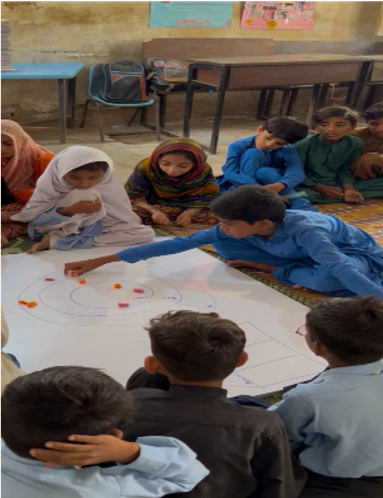
One of the more unexpected and instructive findings from the field came out of a school in Karachi West with a significant Pashto-speaking teacher and student population — part of the wider multi-ethnic, multilingual makeup that defines the district. On a school visit there, it was striking to see how naturally teachers and students alike used Pashto alongside Urdu and Sindhi to scaffold TaRL activities: explaining a grouping exercise in Pashto first, working through a maths concept with a Pashto-language analogy, letting children clarify confusion to each other in their first language before returning to the activity in Urdu.
Far from slowing learning down, this kind of translanguaging appeared to accelerate it. Children who might otherwise sit quietly through an Urdu-medium activity were instead actively explaining concepts to peers, asking questions, and engaging with the material — because the language barrier between understanding a concept and performing it in the language of instruction had been removed. This mirrors a broader pattern seen across Karachi West’s results: a historically multi-ethnic, multilingual district where Urdu is frequently a second or third language for both teachers and students, and where bilingual, mother-tongue-informed scaffolding appears to have helped accelerate gains rather than complicate them.
This is not a fringe observation — it points to something TaRL’s national rollout will need to actively design for rather than treat as an edge case. Pakistan’s own research on foundational learning has already flagged that students whose teachers use their mother tongue to explain lessons, even some of the time, consistently outperform those who don’t. International models echo this: structured mother-tongue bridging strategies, like those used in Senegal’s ARED-supported reading programmes, have shown similar results. As TaRL scales across Sindh — a province itself home to Sindhi, Urdu, Pashto, Balochi, Saraiki, Dhatki, and more — building structured mother-tongue scaffolding into teacher training and learning materials, rather than leaving it to individual teachers’ instinct, could be one of the highest-leverage refinements available to the model.
Why Umerkot matters most to this case?
Umerkot started from a weaker baseline, concentrated in the lowest learning bands, and still finished with a stronger combined Sentence-plus-Story reading share (64.8%) than Karachi West (59.7%), and stronger advanced numeracy (71.9% versus 68.5%). A rural, border, majority-Hindu district with chronic under-investment and limited infrastructure produced better catch-up gains than the urban comparison site. That is precisely the kind of evidence a scale-up case needs: proof that the model doesn’t depend on the advantages of a well-resourced setting to work.
Why it’s the right kind of intervention to scale?
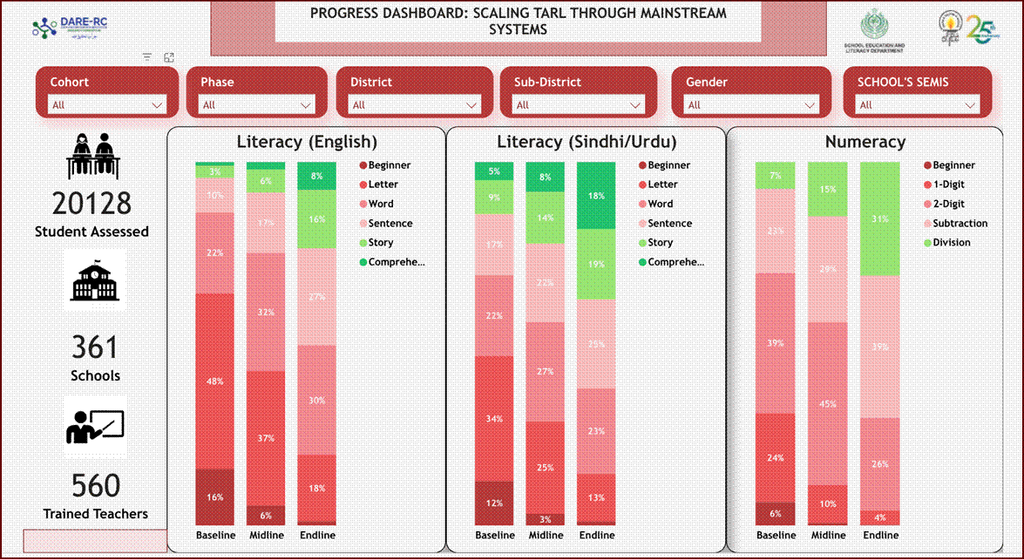
Image 1. Interactive dashboard showing outcomes disaggregated by gender, district and cohort.
Three features make TaRL unusually well-suited to government ownership rather than donor-dependent delivery:
It uses what already exists. No new staff, no new school buildings, no technology procurement. It runs through existing government teachers, inside the existing timetable, using low-cost, reproducible materials — a rare cost-to-impact ratio in foundational learning programming anywhere.
It strengthens the system rather than running alongside it. TaRL’’s teaching and learning resources have already been reviewed and endorsed by DCAR (July 2025) and the training manual approved by STEDA (November 2025). Master Trainers came through PITE-aligned training cycles. None of this lives outside government structures waiting to be “handed over” — it was built inside them from the start.
It has already cleared the political threshold scale-up usually stalls on. On January 6, 2026, the Secretary of SELD formally endorsed TaRL as the province’s foundational learning strategy in front of 35+ senior stakeholders, with development partners including the World Bank, JICA, and UNICEF committing continued support. By May 2026, SELD’s own Technical Working Committee on Foundational Learning had endorsed mainstreaming with a dedicated budget line. The usual bottleneck for proven pilots — government appetite — is not the obstacle here. It has already been cleared.
What scaling requires now?
The project’s own recommendations point to a clear, low-drama pathway: consolidate the tools, dashboards, and protocols built across 560 camps and four cohorts; expand to the districts with the weakest FLN outcomes, timed to start right after summer break; and mainstream TaRL into PITE pre-service training, DCAR/STEDA content cycles, and provincial SELD dashboards, so it becomes a standard feature of middle-primary instruction rather than a project with an end date.
None of this requires reinventing what already exists. It requires Sindh to fund, at provincial scale, a model that has now been tested across the spectrum of its hardest contexts — from Karachi’s dense urban slums to Umerkot’s desert margins — and has outperformed in both.
The window is now
ASER data shows foundational skills have been eroding nationally since 2019, with only a modest uptick in 2025. Every cohort that moves through Grade 3 without catching up becomes a child statistically unlikely to catch up later. Sindh now holds something genuinely uncommon in education policy: a government-endorsed, third-party-validated, dual-context-tested model, with the delivery infrastructure for it already standing. The evidence is no longer the question. What happens next is whether the system funds and institutionalizes what it has already proven works — or lets another cohort of children move through without it.
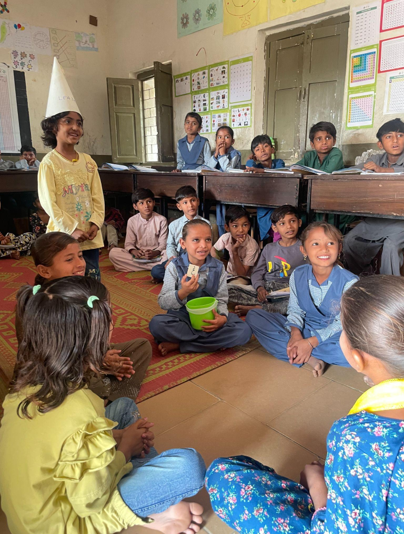
This is an experiential evidence based narrative of a rapid paced TARL/FL roll out by the system and within the system. Greater engagement with parents /communities and SMCs is critical as is that of provincial SELD/RSU STEDA/ PITE leadership to witness how TARL can be and should be part of school and classroom routines within strong district support systems to strengthen Foundational Learning as a right to education in Pakistan.
Note: the project has a detailed dashboard that is an accessible data point for each child with a unique ID and tracking system.