
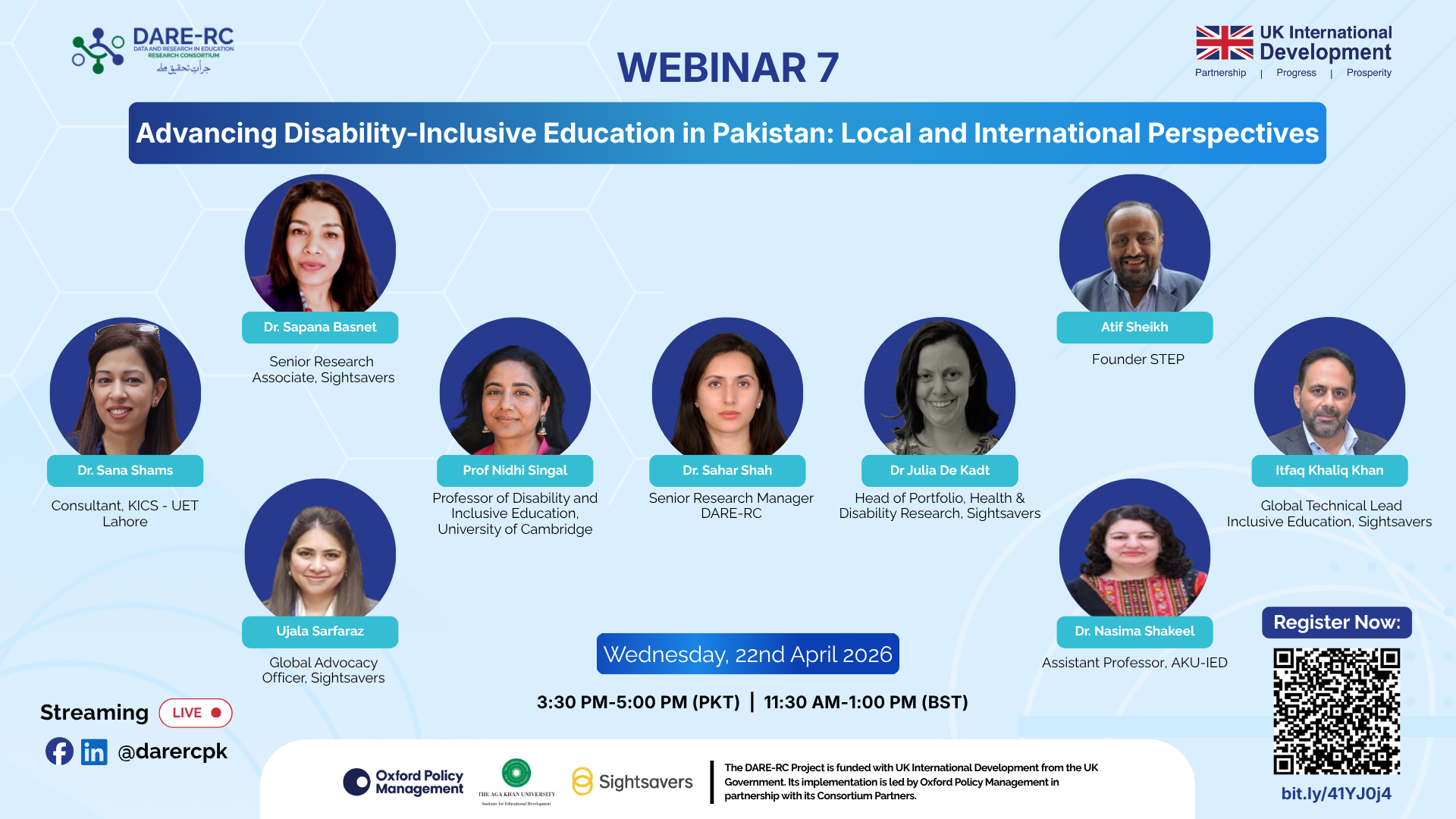
The Data and Research in Education – Research Consortium (DARE-RC) successfully hosted the latest session of its webinar series, Building Communities of Practice in Education, convening researchers, policymakers, practitioners, and disability advocates to explore practical, evidence-based pathways for advancing disability-inclusive education in Pakistan. DARE-RC is a pioneering education research initiative generating actionable insights to inform education reform nationwide. The programme is led by Oxford Policy Management (OPM) in collaboration with Aga Khan University Institute for Educational Development (AKU-IED) and Sightsavers, and is funded by the Foreign, Commonwealth and Development Office (FCDO).
The webinar, titled ‘Advancing Disability-Inclusive Education in Pakistan: Local and International Perspectives’, featured contributions from Dr. Julia De Kadt, Mr. Itfaq Khaliq Khan, Dr. Sapana Basnet, Dr. Nasima Shakeel, Dr. Sana Shams and Mr Atif Sheikh, and was moderated by Dr. Sahar Shah, Senior Research Manager at DARE-RC. Dr Nidhi Singal provided reflections on the wider international significance of the findings while Ms. Ujala Sarfaraz and Mr. Muhammad Atif Sheikh provided policy perspectives and lived experiences respectively.
The session focused on one of Pakistan’s most pressing education challenges: ensuring that children with disabilities are not only enrolled in school, but able to participate meaningfully and learn in inclusive environments. Dr Julia De Kadt highlighted that while many children with disabilities are present in mainstream public schools, their participation is often constrained by inaccessible infrastructure, limited teacher preparedness, weak school-family engagement, and persistent stigma within communities. Dr Nasima Shakeel further noted that barriers are often compounded by poverty, gender, and low parental awareness, making exclusion multidimensional rather than singular.
A central component of the discussion examined the role of disability-inclusive data systems. Findings presented by Mr. Itfaq Khaliq Khan demonstrated that integrating the Washington Group Questions on Disability into Pakistan’s Annual School Census represents an important step forward, but implementation challenges remain. These include under-reporting of disability prevalence, inconsistent data collection practices, limited training, and low awareness regarding the purpose and use of disability data. The presenters emphasised that stronger learner-centred data systems are essential for planning and monitoring inclusive education reforms.
The webinar also explored the growing intersection between disability inclusion and climate resilience. As explained by Dr. Sapana Basnet, children with disabilities often face disproportionate disruption during floods, heatwaves, political unrest, and other emergencies. Dr Basnet stressed that resilience must be understood not only as school reopening, but as continuity of safe learning, accessible transport, wellbeing support, and re-engagement after absence. Participants heard that ‘climate hazards do not affect everyone equally,’ reinforcing the need for disability-responsive planning within school systems.
Technology-enabled inclusion was another major theme of the session. Dr. Sana Shams presented innovative work on improving access for deaf learners through tools that convert speech and text into Pakistan Sign Language (PSL). The findings suggested that such platforms can support both children and parents through self-paced learning, while also helping address longstanding barriers caused by limited sign language resources and communication gaps at home and school.
In discussion with Dr. Sahar Shah, Prof Nidhi Singal emphasised the importance of repositioning disability inclusion as a system-wide policy priority rather than a standalone welfare concern. The ‘right to be counted’, she stated, ‘is an equally important phenomenon as preparing for developing climate resilient education systems.’ Integrating inclusive disaster risk reduction into project design is essential to ensure that no one and especially people with disabilities, are left behind.
Summing up learnings from all the discussed studies, Ms Ujala highlighted policy recommendations for inclusive education in the Pakistani context. These included embedding disability-responsive indicators into education data systems, investing in teacher training and accessible infrastructure, strengthening provincial budgeting for inclusion, supporting assistive and digital technologies, and ensuring coordination across education, disability, and climate resilience frameworks.
Ms Atif Sheikh, a renowned disability-inclusive development advocate, described his lived experiences and the motivation behind developing the only disabled people’s organization in South Asia. He stressed on the need to introduce adaptive technology to ensure every child reaches the classroom and that it is crucial to understand the aspect of disability in the environment before trying to actually embed it into the education system.
This episode of the Building Communities of Practice in Education series highlights DARE-RC’s continued commitment to translating rigorous research into practical, scalable solutions. By bringing together evidence on disability, technology, resilience, and policy reform, the webinar contributed to an action-oriented dialogue on building a more inclusive and equitable education system in Pakistan.